Astronaut Edward Tsang Lu To Discuss Preventing Asteroid Impacts
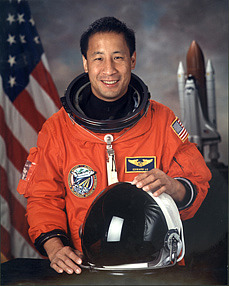
Edward Tsang Lu, research physicist and NASA astronaut, will present "Preventing Asteroid Impacts: A Gravitational Tractor for Towing Asteroids" on Friday, April 28, at 5:00 p.m. in Wolfensohn Hall on the campus of the Institute for Advanced Study.
On April 13, 2036, there will be a one-in-5,000 chance of asteroid 99942 Apophis striking the Earth. On May 4, 2104, there is a one-in-1,500 chance of asteroid 2004VD17 striking the Earth.
In his lecture, Dr. Lu will discuss our options if upcoming observations show that an impact is imminent. He will describe a simple method of nudging an asteroid to prevent impact using a Gravitational Tractor spacecraft. Such a vehicle would need merely to hover above the asteroid and use the slight mutual pull of gravity to slowly and controllably deflect the asteroid.
Dr. Lu says that such a spacecraft could be built using existing technology, and it could be used to deflect asteroid 99942 Apophis should future observations show that to be necessary.
After earning a B.S. degree in electrical engineering from Cornell University in 1984, Dr. Lu received his Ph.D. in applied physics from Stanford University in 1989. Dr. Lu then worked as a research physicist in the fields of solar physics and astrophysics. He was a visiting scientist at the High Altitude Observatory in Boulder, Colorado, from 1989 until 1992, the final year holding a joint appointment with the Joint Institute for Laboratory Astrophysics at the University of Colorado. From 1992 until 1995, he was a postdoctoral fellow at the Institute for Astronomy in Honolulu, Hawaii.
Dr. Lu joined NASA in 1995 and has served as lead astronaut for Space Station training and lead astronaut for Shuttle training. His Shuttle missions include the STS-84 Atlantis (May 15-24, 1997), which was NASA�s sixth Shuttle mission to rendezvous and dock with the Russian Space Station Mir. In completing this mission, Dr. Lu traveled 3.6 million miles in 144 orbits of the Earth logging a total of 9 days, 5 hours, 19 minutes, and 55 seconds in space.
He was also a member of the team on the STS-106 Atlantis (September 8-20, 2000). During the 12-day mission, the crew successfully prepared the International Space Station for the arrival of the first permanent crew. He and Yuri Malenchenko performed a 6 hour and 14 minute space walk in order to connect power, data and communications cables to the newly arrived Zvezda Service Module and the Space Station in a mission that orbited the Earth 185 times, and covered 4.9 million miles in 11 days, 19 hours, and 10 minutes.
On the ISS Expedition-7 (April 25 to October 27, 2003), Dr. Lu was the first American to launch as the Flight Engineer of a Soyuz spacecraft, and the first American to launch and land on a Soyuz spacecraft (Soyuz TMA-2). As Flight Engineer and NASA ISS Science Officer, he spent a successful 6-month tour of duty aboard the International Space Station maintaining ISS systems and overseeing science operations. In completing this mission, Dr. Lu logged 184 days, 21 hours and 47 minutes in space.
A member of the American Astronomical Society, the Aircraft Owners and Pilots Association and the Experimental Aircraft Association, Dr. Lu has garnered numerous honors, including the NASA Exceptional Service Medal, NASA Distinguished Service Medal, Gagarin Medal, Komorov Medal, Beregovoy Medal and three NASA Spaceflight medals.
For further information about this event, which is free and open to the public, please call (609) 734-8175.