Angelika Neuwirth Addresses the "Late Antique Qur'an" in a Lecture at the Institute for Advanced Study
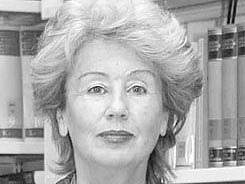
Angelika Neuwirth, Professor at the Freie Universität Berlin and Member in the School of Historical Studies, will discuss “The ‘Late Antique Qur'an’: Jewish-Christian Liturgy, Hellenic Rhetoric and Arabic Language” on Wednesday, June 3, at 4:30 p.m. in the West Building Lecture Hall at the Institute for Advanced Study.
A leading scholar of the Qur’an, Dr. Neuwirth will discuss whether it should be viewed as an exclusively Islamic text. She will address ways it which it may be seen as both Islamic and Late Antique. According to Neuwirth, before the Qur’an was recognized as Muslim scripture, it was communicated to an audience whose education was based on late-antique traditions—Judeo-Christian, Hellenic and Arabian. She will explore how, when read as a movement within this triangle, the Qur’an turns out to be a Near Eastern–European text.
Support for the lecture is provided by the Dr. S. T. Lee Fund for Historical Studies.
After earning her Ph.D. in Semitic Studies from University of Goettingen in 1972, Neuwirth was awarded her Habilitation in Arabic and Islamic Studies from the University of Munich in 1977. She was a Visiting Professor (1977–83) at the University of Jordan and supervisor of the Catalogue of Arabic Manuscripts (1981–83) at the Royal Aal al-Bayt Institute for Islamic Thought. She served as Professor (1984) at the University of Munich and at Bamberg University (1984–91). A Visiting Professor (1988-89) at Ain Shams University in Cairo, Neuwirth joined the Freie Universität Berlin as Professor in 1991, a position she continues to hold.
The author of numerous articles and books, Neuwirth served as Director (1994–99) of the Orient-Institute of Deutschen Morgenländischen Gesellschaft in Beirut and Istanbul. Among her many activities, she has taught annual courses on Islamic scripture and liturgy at the Benedictine Abbey Santa Maria Zion in Jerusalem since 1985.
For further information about this event, which is free and open to the public, please call (609) 734-8175, or visit the Public Events page on the Institute website, www.ias.edu.