Etched in History: Eiffel Tower to Honor IAS Trailblazers
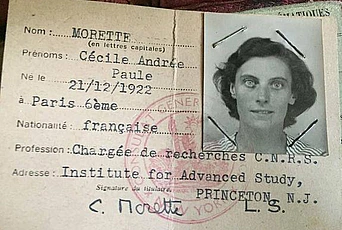
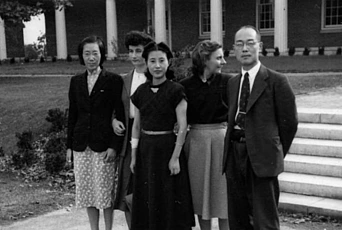
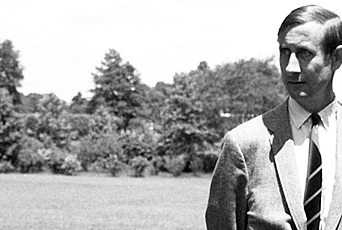
It is anticipated that the Eiffel Tower will be engraved this year with the names of 72 women scientists—including three former Institute scholars: Cécile DeWitt-Morette, Member (1948–50) in the School of Mathematics; her friend and coauthor Yvonne Choquet-Bruhat, Member (1951–52, 1955) in the School; and Jacqueline Ferrand, Member (1956) in the School.
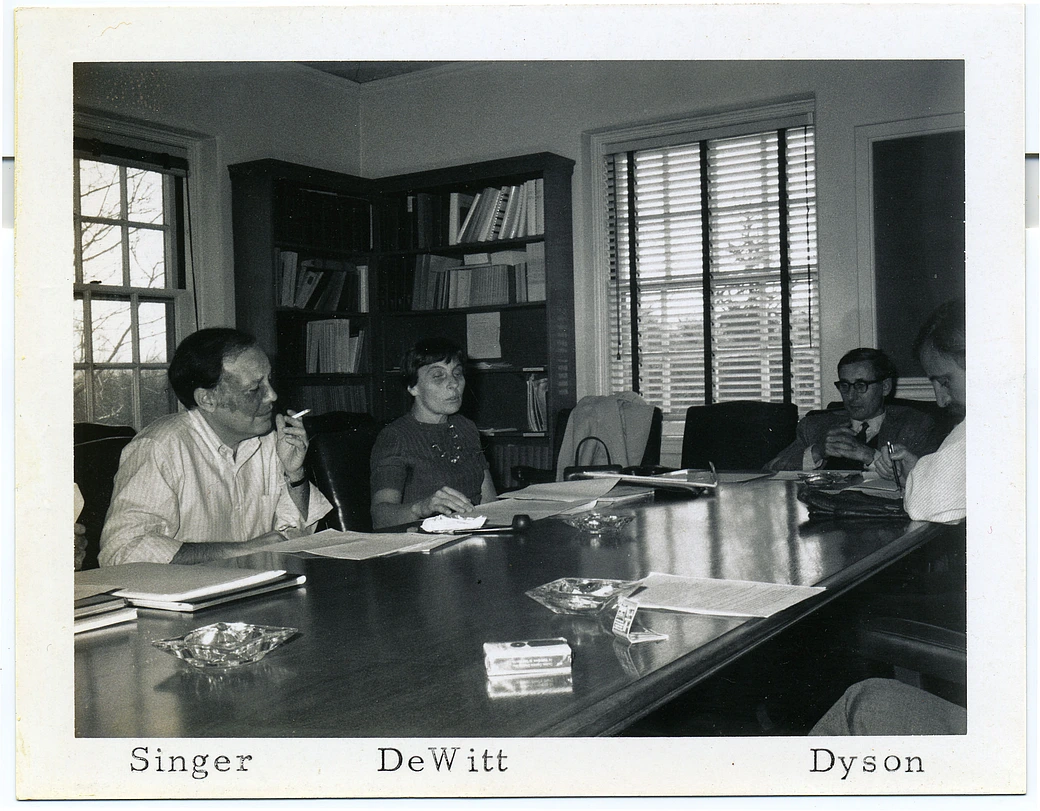
DeWitt-Morette was a French mathematician and physicist whose contributions to IAS, the greater field of quantum mechanics, and the revitalization of scientific research in creating the famous School of Les Houches renders her notable among the many figures to have graced the halls of the Institute. Due to the spatial limitations of the tower frieze, her name will be represented as simply "DeWitt" on the landmark.
On her remarkable mind, Freeman Dyson, Professor (1953–2020) in the School of Natural Sciences, wrote in an introduction to a letter written by prominent physicist Richard Feynman:
In the next letter a great woman appears, whose name was then Cécile Morette and is now Cécile DeWitt. She was in 1948 a member of the Institute for Advanced Study, having arrived from France via Dublin and Copenhagen. She was the first of the younger generation to grasp the full scope and power of the Feynman path integral approach to physics. While I was concerned with applying Feynman’s methods to detailed calculations, she was thinking of larger issues, extending the path integral idea to everything in the universe including gravitation and curved space-times.
Choquet-Bruhat was a mathematical physicist now remembered for her investigation of the mathematics of general relativity. In particular, she established the existence of propagation phenomena, providing the first evidence of the physical reality of gravitational waves. An obituary published by the Institut des Hautes Études Scientifiques (IHES) lauded Choquet-Bruhat’s “extensive body of work, including the classic textbook Analysis, Manifolds and Physics, co-authored with Cécile DeWitt-Morette and Margaret Dillard-Bleick, [which] has influenced generations of researchers.”
Ferrand is best known for her work on conformal representation theory, potential theory, and Riemannian manifolds. Her most celebrated achievement was providing the definitive proof for the Lichnerowicz conjecture, a major breakthrough that characterized the conformal transformation groups of compact Riemannian manifolds. In addition to publishing nearly a hundred research papers, she was a trailblazer for women in French academia who mentored generations of future mathematicians as a professor at the University of Paris.
DeWitt-Morette, Choquet-Bruhat, Ferrand, and the other women join the 72 notable men whose names have adorned the first-floor frieze of the Eiffel Tower for over 130 years. Gustave Eiffel, the French civil engineer whose company designed the tower, is himself commemorated there. A committee at Sorbonne University spanning faculty in the sciences, humanities, and medicine was formed to select the new names.
The engraving thus honors not only the consequential achievements of individual women, but a community of female scientists whose minds have shaped the fields of mathematics, physics, chemistry, and biology.