Book Talk with Joan Judge
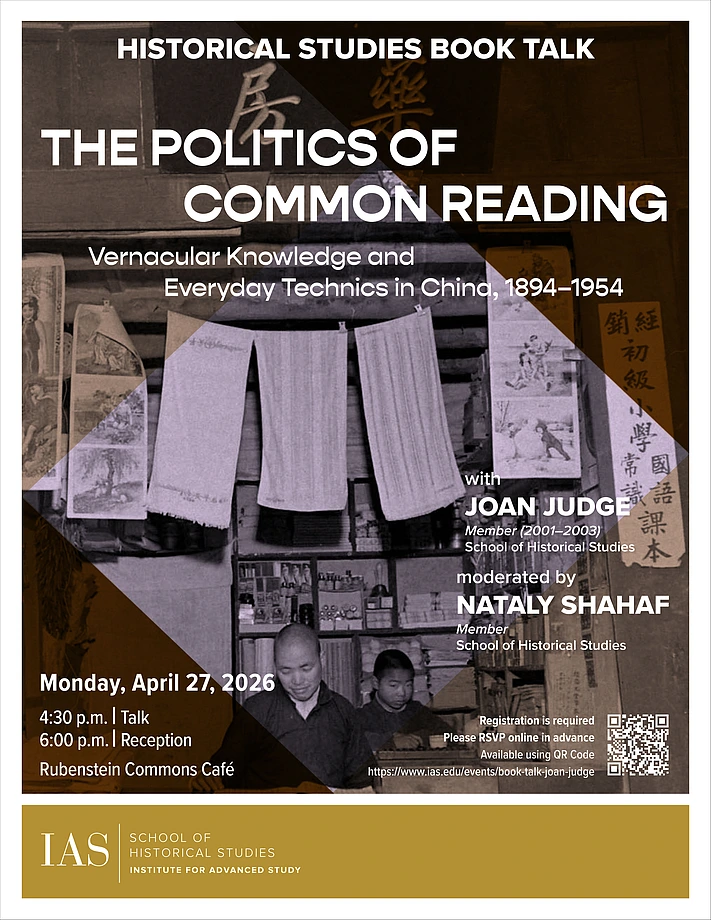
Historical Studies Book Talk with Joan Judge
Monday, April 27
4:30 p.m. | Talk
6:00 p.m. | Reception
Rubenstein Commons Café
The Politics of Common Reading: Vernacular Knowledge and Everyday Technics in China, 1894–1954, moderated by Nataly Shahaf
What did common readers read in the midst of China’s twentieth-century revolutions? How did they manage the challenges of the era—from new technologies to novel diseases, from institutional failure to commercial globalization? What did they know and how did they know it?
These are the questions that animate The Politics of Common Reading: Vernacular Knowledge and Everyday Technics in China. In this book talk, Joan Judge introduces a gallery of common readers and the methodological challenges they pose for the historian of literacy, print, and knowledge. She examines the practical problems these readers confronted, the informal epistemic infrastructure that served them, and a consequential politics of accommodation that engaged them as knowers rather than as an unenlightened mass.
Joan Judge, Member (2001–2003) in the School of Historical Studies, is a Fellow of the Royal Society of Canada, a 2021 Guggenheim Fellow, and a Professor in the Department of History at York University in Toronto. A cultural historian of print and knowledge in modern China, she is the author of The Politics of Common Reading: Vernacular Knowledge and Everyday Technics in China, 1894–1954 (University of Chicago Press, 2025); Republican Lens: Gender, Visuality, and Experience in the Early Chinese Periodical Press (University of California Press, 2015); The Precious Raft of History: The Past, the West, and the Woman Question in China (Stanford University Press, 2008); and Print and Politics: ‘Shibao’ and the Culture of Reform in Late Qing China (Stanford University Press, 1996). She is also co-editor of The Sinosphere and Beyond: Essays in Honor of Joshua Fogel (DeGruyter Oldenbourg, 2024); “Publishing for Daily Life in Early Modern East Asia,” (special issue of Lingua Franca: The History of the Book in Translation 6 [2020]); Women Warriors and National Heroes: Global Histories (Bloomsbury Academic, 2020); Women and the Periodical Press in China’s Global Twentieth Century: A Space of Their Own? (Cambridge University Press, 2018); and Beyond Exemplar Tales: Women’s Biography in Chinese History (University of California Press, 2011). She is currently leading an international collaborative project on “Vernacular Medicine and Modes of Knowing in China.”
Nataly Shahaf, Member in the School of Historical Studies, is a joint postdoctoral fellow at the Shelby Cullom Davis Center for Historical Studies at Princeton University and the School of Historical Studies at the Institute for Advanced Study. She received her Ph.D. in East Asian Languages and Cultures from Columbia University in 2023, specializing in modern Chinese history and religion. Her research examines Buddhism in modern China, with a focus on how media technologies, scientific thought, and religious practice shaped understandings of the visible and invisible worlds. Her current book project, Multiple Exposures: Ghost Photography, Buddhism, and Visual Heritage in Early Twentieth-Century China, explores how photography and print culture enabled Buddhist communities to materialize religious presence and engage global debates on science, spiritualism, and technology.