Roger E. Covey Distinguished Lecture in Premodern China Studies
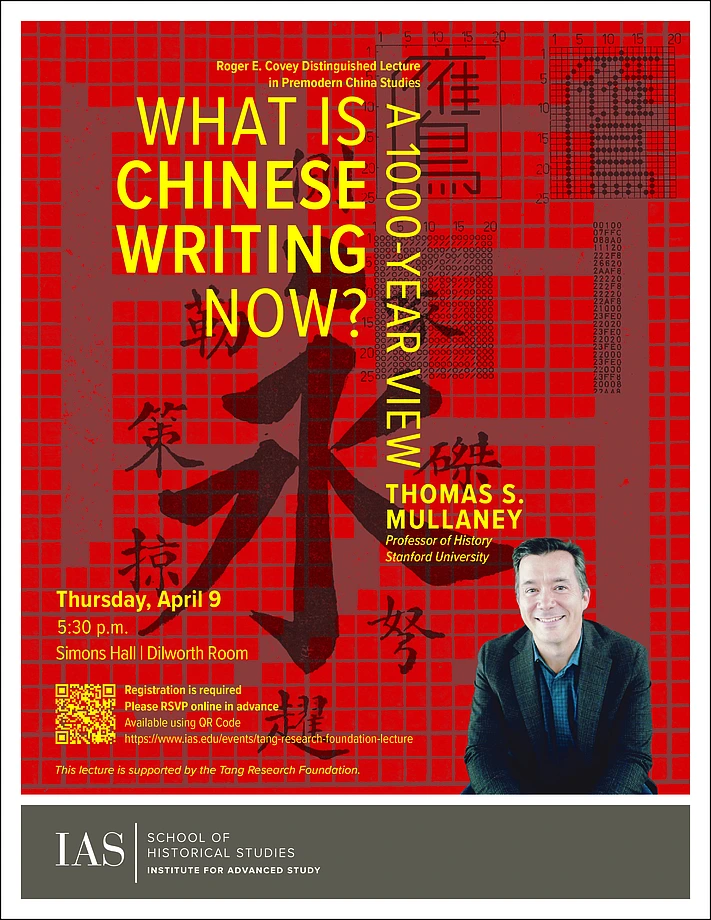
Roger E. Covey Distinguished Lecture in Premodern China Studies
Thursday, April 9, 2026
5:00 p.m. | Reception
5:30 p.m. | Talk
Simons Hall | Dilworth Room
What Is Chinese Writing Now?: A 1000-Year View
The emergence of mechanized Chinese writing in the nineteenth century and digital Chinese writing in the twentieth posed profound practical and conceptual challenges to a writing system whose history spans millennia. The dynamism, reach, and efficacy of woodblock printing, for example, gave rise to seemingly irresolvable puzzles: How does one “fit” 100,000 Chinese characters inside Morse Code? How does one fit them on typewriter and computer keyboards?
In confronting these challenges, a motley, transnational throng of engineers, linguists, state-builders, and everyday users did more than solve a series of wicked-hard technical problems. They fashioned an entirely new mode of Chinese writing—indeed, a new way of thinking about writing itself—which I call hypography: a mode of writing in which the primary act is no longer the production of signs in any conventional semiotic sense, but instead the search for, selection of, and retrieval of Chinese characters and other glyphs from memory. In the digital age, the act of “writing Chinese” has become the act of “writing symbols with which to find Chinese characters."
This shift coincided with a deeper transformation in the material logic of writing technologies worldwide. Pre-modern modes of inscription—be they woodblock printing, calligraphy, epigraphy, or lithography—all shared at least one thing in common: they all functioned through the addition or subtraction of matter. Ink laid down. Wood gouged out. Mass augmented or mass reduced. However, Chinese telegraphy, typewriting, and computing functioned in a completely different way. A telegraph cable did not become heavier or more massive in times of high traffic, or lighter once transmissions ceased. And today, a hard drive, an SSD, or a USB stick “full” of Chinese-character texts weighs exactly the same as when those storage devices are “empty.” The modern digital age remains just as “material” as that of the pre-modern, (nothing is ever truly “virtual" in media history), and yet the behavior of this materiality in the mechanical and digital age functions in ways utterly dissimilar from its premodern antecedents.
In this talk, Professor Mullaney will pose a question—what is Chinese writing now?—and adopt a 1000-year timeframe to examine the transition between two distinct epochs of writing: orthography (writing as we’ve understood it for so long), and hypography (a form of writing we are only beginning to grasp).
Thomas S. Mullaney is Professor of History and Professor of East Asian Languages and Cultures, by courtesy. He is also Director of Stanford’s Program in Science, Technology and Society, a Guggenheim Fellow, and a former Kluge Chair in Technology and Society at the Library of Congress. He is the author or lead editor of eight books, including How We Disappear: A Personal History of Information, The Chinese Computer: A Global History of the Information Age, The Chinese Typewriter (winner of the Fairbank prize), Your Computer is on Fire, and Coming to Terms with the Nation: Ethnic Classification in Modern China.
This lecture is supported by the Tang Research Foundation.
Register below to attend.