Irit Dveer Dinur and Collaborators to Receive NAS Prize in Computer Science
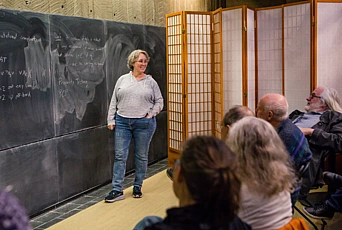
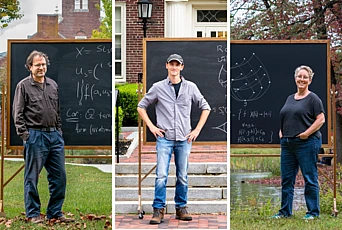
This January, the National Academy of Sciences (NAS) announced five recipients of its 2026 Michael and Sheila Held Prize—all of whom are current or former scholars in the School of Mathematics at the Institute for Advanced Study. Irit Dveer Dinur, Betsey Lombard Overdeck Theory of Computing Professor, was recognized alongside Dor Minzer, Member (2018–20); Subhash Khot, Member (2003–04); Shmuel Avraham Safra, Member (2004–05); and Guy Kindler, Member (2004–05), for their joint work on a proof of the 2-to-2 Games Theorem.
Described as a “monumental achievement” in the NAS citation, the multi-year collaboration between Dinur, Minzer, Khot, Safra, and Kindler represents a significant advancement in one of the most important open questions in theoretical computer science, the Unique Games Conjecture. According to NAS, their proof “has profoundly altered the landscape of hardness of approximation and Probabilistically Checkable Proofs, introducing deep new insights into combinatorics and discrete analysis. The theorem itself has important consequences for problems such as vertex cover and graph coloring.”
The team will receive the award on April 26, 2026. Established in 2017 by Michael and Sheila Held, the prize is “presented annually to honor outstanding, innovative, creative, and influential research in the areas of combinatorial and discrete optimization, or related parts of computer science.”
In addition to Dinur and her collaborators, Roman Bezrukavnikov, frequent Member in the School of Mathematics, was announced as the recipient of the NAS's 2026 Maryam Mirzakhani Prize in Mathematics "for his seminal contributions to geometric representation theory." The citation continues: "His extensive work has established the importance of categories of coherent sheaves in the field, introduced fundamental new tools arising from positive characteristic, and resolved central questions about modular representations of semi-simple Lie algebras."
Read more on the National Academy of Sciences website.