Connecting Minds in Combinatorics: PCMI 2025
This summer, Park City, Utah once again became a vibrant hub for mathematical exploration as 198 participants from 21 countries around the world gathered for the 2025 iteration of the Park City Mathematics Institute (PCMI), an annual outreach initiative of the Institute for Advanced Study. The focus for this year’s program was “Extremal and Probabilistic Combinatorics,” a dynamic area at the intersection of discrete mathematics and probability theory.
Extremal combinatorics investigates the largest or smallest possible size of a structure that meets certain criteria, while probabilistic combinatorics uses randomness and probabilistic techniques to analyze combinatorial objects. These two fields have seen remarkable growth in recent years, influencing a wide range of mathematical disciplines, from geometry and number theory to statistical physics and theoretical computer science.
PCMI 2025 was organized by Julia Böttcher of the London School of Economics; Jacob Fox of Stanford University; Penny Haxell of the University of Waterloo; Robert Morris of IMPA; and Wojciech Samotij of Tel Aviv University.
Over the course of three intensive weeks, PCMI offered a suite of parallel programs designed to engage mathematicians at every stage of their careers. The Research Program provided established scholars with the opportunity to collaborate, share their latest findings, and interact with emerging talent. The informal and collegial atmosphere fostered lively discussions and new collaborations, while the presence of participants from across the mathematical spectrum—ranging from undergraduates to high school teachers—created a broad and collaborative environment.
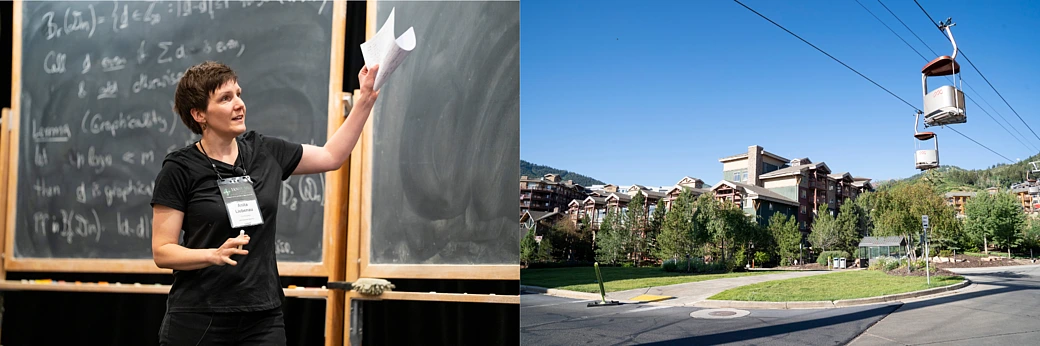
The Graduate Summer School (GSS) formed the academic heart of PCMI, featuring a series of nine minicourses led by leading experts in extremal and probabilistic combinatorics. Each minicourse consisted of three to five lectures, carefully structured to accommodate both newcomers to the field and more advanced students. Daily problem sessions accompanied each course, giving participants the chance to deepen their understanding and hone their problem-solving skills. The GSS was further enriched by opportunities for graduate students to interact with researchers at all levels, participate in the Experimental Math Lab, and attend a variety of cross-program lectures and social events.
Undergraduate students took part in the Undergraduate Summer School (USS), which offered a unique blend of lectures and hands-on mathematical exploration. This year’s USS featured a daily lecture series by Yuval Wigderson of ETH Zürich on “Extremal Graph Theory and Ramsey Theory,” introducing students to fundamental questions about the structure of graphs and the surprising connections between combinatorics, geometry, number theory, and computer science. Morning sessions focused on experimental mathematics, encouraging students to tackle open-ended problems and engage in computational work. The USS provided undergraduates with a rare opportunity to interact informally with graduate students and researchers, which often leads to lasting mentorships and shaping future academic paths.
Faculty from undergraduate-focused institutions participated in the Undergraduate Faculty Program (UFP), led in 2025 by Cory Palmer of the University of Montana. The UFP explored the “Combinatorics of Forbidden Substructures,” delving into classic results and powerful techniques such as the Szemerédi Regularity Lemma and the Probabilistic Method. Participants worked together on current research questions and open problems, while also engaging with the broader PCMI community through shared lectures and collaborative activities.
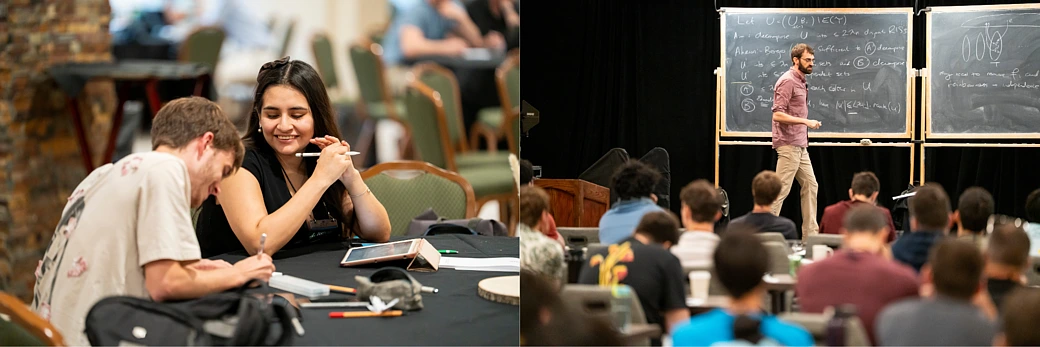
Beyond the formal academic offerings, PCMI 2025 featured a rich array of cross-program activities, including lectures accessible to all participants, the Experimental Math Lab, and a variety of social events designed to foster connections across different groups. The beautiful setting of Park City provided ample opportunities for outdoor recreation and informal gatherings, further enhancing the sense of community.
PCMI 2025 was made possible through generous support from the Simons Foundation and the National Science Foundation (NSF). This year’s Clay Senior Scholars, who attended with support from the Clay Mathematics Institute, were János Pach (Rényi Institute of Mathematics and NYU) and Noga Alon (frequent Visiting Professor in the Institute’s School of Mathematics, based at Princeton University).
Video recordings of this year’s lectures are available on the PCMI YouTube channel.
The next iteration of PCMI, which will be held from June 27–July 17, 2026, will focus on “Knotted Surfaces in Four-Manifolds.” Additional information about the program and a call for applications will be available on the PCMI website in November 2025. In addition to this, PCMI currently has an open call to organize a summer session in 2027 and 2028. Information about how to propose a session can be found here.