Vladimir Voevodsky to Discuss New Foundations of Mathematics in Lecture at Institute for Advanced Study
PRESS CONTACT: Alexandra Altman, (609) 951-4406
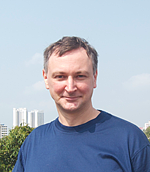
On Wednesday, March 26, Vladimir Voevodsky, Professor in the School of Mathematics at the Institute for Advanced Study, will give a public lecture, “Univalent Foundations: New Foundations of Mathematics,” which will take place at 4:30 p.m. in Wolfensohn Hall on the Institute campus. The Institute for Advanced Study is pleased to designate this lecture in honor of the Princeton Adult School’s 75th Anniversary. The Institute supports and shares the Adult School’s mission to promote and foster lifelong learning and exploration in the Princeton community and beyond.
According to Voevodsky, the work of a mathematician is 5% creative insight and 95% self-verification. Moreover, the more original the insight, the more one has to pay for it later in self-verification work. The Univalent Foundations project, started at the Institute a few years ago, aims to lower the price by giving mathematicians the ability to verify their constructions with the help of computers. Voevodsky will explain how new ideas that make this goal attainable arise from the meeting of two streams of development—one in constructive mathematics and the theory and practice of programming languages, and the other in pure mathematics.
Voevodsky is known for his work in the homotopy theory of schemes, algebraic K-theory and interrelations between algebraic geometry and algebraic topology. He made one of the most outstanding advances in algebraic geometry in the past few decades by developing new cohomology theories for algebraic varieties. Among the consequences of his work are the solutions of the Milnor and Bloch-Kato Conjectures. Currently, Voevodsky is interested in type-theoretic formalizations of mathematics and automated proof verification. He is working on new foundations of mathematics based on homotopy-theoretic semantics of Martin-Lof type theories.
Voevodsky was awarded the prestigious Fields Medal in 2002 for his work in developing a homotopy theory for algebraic varieties and formulating motivic cohomology. Voevodsky has been awarded many additional honors including the Sloan and Clay Prize Fellowships, and is a member of the European Academy of Sciences.
Voevodsky received his Ph.D. in 1992 from Harvard University, where he was Fellow from 1993–96, and a Visiting Scholar from 1996–97 and 2006–08. Additionally, Voevodsky was a Visiting Scholar at the Max Planck Institute from 1996–97. Prior to joining the Institute, Voevodsky was an Associate Professor at Northwestern University during 1996–99. After having visited the Institute for Advanced Study on several occasions as a Member from 1992–93 and 1998–2001, he joined the Faculty of the School of Mathematics in 2002.
To learn more about the Univalent Foundations Project visit the Summer 2013 Institute Letter. For more information on other lectures at the Institute, visit http://www.ias.edu/news/public-events.
About the Institute for Advanced Study
The Institute for Advanced Study is one of the world’s leading centers for theoretical research and intellectual inquiry. The Institute exists to encourage and support curiosity-driven research in the sciences and humanities—the original, often speculative thinking that produces advances in knowledge that change the way we understand the world. Work at the Institute takes place in four Schools: Historical Studies, Mathematics, Natural Sciences and Social Science. It provides for the mentoring of scholars by a permanent Faculty of approximately 30, and it ensures the freedom to undertake research that will make significant contributions in any of the broad range of fields in the sciences and humanities studied at the Institute.
The Institute, founded in 1930, is a private, independent academic institution located in Princeton, New Jersey. Its more than 6,000 former Members hold positions of intellectual and scientific leadership throughout the academic world. Thirty-three Nobel Laureates and 40 out of 56 Fields Medalists, as well as many winners of the Wolf and MacArthur prizes, have been affiliated with the Institute.