Matias Zaldarriaga to Discuss New Map of the Infant Universe in Lecture at Institute for Advanced Study
PRESS CONTACT: Katherine Belyi, (609) 951-4406
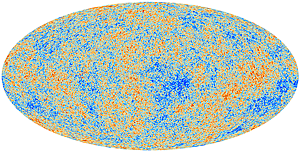
This March, the first cosmological data from the Planck satellite was publically released. This detailed map of the infant universe shows relic radiation from the Big Bang, imprinted when the universe was just 380,000 years old. On Friday, May 3, Matias Zaldarriaga, Professor in the School of Natural Sciences, will give a public lecture reviewing the new results and explaining where they fit in our broader understanding of the beginnings and evolution of the universe. The lecture, “The Latest News from the Cosmos,” will take place at 5:30 p.m. in Wolfensohn Hall on the Institute campus.
Much of Zaldarriaga’s work centers on understanding clues about the earliest moments of the universe as encoded in the Cosmic Microwave Background, the faint glow of radiation generated by the Big Bang. The Planck satellite, which measures this radiation, is a mission of the European space agency initiated in 1996 and involving hundreds of scientists in more than 13 countries. Cosmologists have used the Planck satellite data to compile the first all-sky image of the distribution of dark matter across the entire history of the universe.
Zaldarriaga, a Professor at the Institute since 2009, has made influential contributions to particle astrophysics and cosmology. With Uros Seljak, he developed a technique for accelerated calculations of properties of the Cosmic Microwave Background. His recent research has focused on intergalactic hydrogen gas in the early universe.
Zaldarriaga studied at the University of Buenos Aires and at the Massachusetts Institute of Technology, from which he earned his Ph.D. in 1998. He was a Long-term Member at the Institute from 1998 to 2001 and served as W. Keck Visiting Associate in Cosmology at the Institute from 2001 to 2002. He has served on the faculties of New York University and Harvard University, where he became a full Professor in 2004, with appointments in both the departments of astronomy and physics.
Zaldarriaga was awarded the 2005 Gribov Medal of the European Physical Society and the 2003 Helen B. Warner Prize of the American Astronomical Society. He was awarded a MacArthur Fellowship in 2006, and he is also the recipient of Packard and Sloan Fellowships.
For further information about the lecture, which is free and open to the public, call (609) 734-8175, or visit the Institute website, www.ias.edu.
About the Institute for Advanced Study
The Institute for Advanced Study is one of the world’s leading centers for theoretical research and intellectual inquiry. The Institute exists to encourage and support curiosity-driven research in the sciences and humanities—the original, often speculative thinking that produces advances in knowledge that change the way we understand the world. Work at the Institute takes place in four Schools: Historical Studies, Mathematics, Natural Sciences and Social Science. It provides for the mentoring of scholars by a permanent Faculty of approximately 30, and it ensures the freedom to undertake research that will make significant contributions in any of the broad range of fields in the sciences and humanities studied at the Institute.
The Institute, founded in 1930, is a private, independent academic institution located in Princeton, New Jersey. Its more than 6,000 former Members hold positions of intellectual and scientific leadership throughout the academic world. Thirty-three Nobel Laureates and 40 out of 56 Fields Medalists, as well as many winners of the Wolf and MacArthur prizes, have been affiliated with the Institute.