Didier Fassin to Discuss the Changing Landscape of Asylum in Lecture at Institute for Advanced Study
PRESS CONTACT: Katherine Belyi, (609) 951-4406
Didier Fassin, James D. Wolfensohn Professor in the School of Social Science at the Institute for Advanced Study, will deliver a public lecture, “The Arduous Path of Refugees in the Changing Landscape of Asylum” on Wednesday, April 3. Drawing on ten years of research, the lecture will examine significant changes in the conception of the right to asylum in recent decades and the ordeal faced by asylum seekers as they go through complex administrative and judiciary procedures in order to have their status acknowledged. The lecture will take place at 4:30 p.m. in Wolfensohn Hall on the Institute campus.
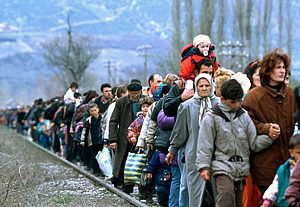
An institution dating from Antiquity and formally recognized with the 1951 Geneva Convention on Refugees, asylum has been confronted with a dramatic increase in applicants during the past century. This burden has been unevenly distributed: refugees are massively concentrated in camps of the global South, particularly Sub-Saharan Africa and Central Asia. In the global North, asylum seekers are selected on a case-by-case basis, under pressure of growing suspicion toward so-called bogus refugees.
Beyond the study of the refugee problem, this lecture will look at efforts of asylum seekers and contemporary societies to place responsibility for protecting the victims of violence.
Fassin is an anthropologist and sociologist who has conducted field studies in Senegal, Ecuador, South Africa and France. He dedicated his early research to medical anthropology, examining the AIDS epidemic, social inequalities in health and the changing landscape of global health. More recently, he has developed political and moral anthropology, a new domain of inquiry into the reformulation of injustice and violence as suffering and trauma, the expansion of an international humanitarian government and contradictions in the politics of contemporary society. His present project explores the political and moral treatment of disadvantaged groups, including immigrants and refugees, through an ethnography of police, justice and prison.
Initially trained as a physician at Université Pierre et Marie Curie in Paris, Fassin practiced internal medicine and taught public health before turning to the social sciences. He completed a master’s degree at the Sorbonne and a Ph.D. at the École des Hautes Études en Sciences Sociales (ÉHESS). He has served as Professor at Université Paris Nord and Director of Studies at ÉHESS. At CNRS, the Centre National de la Recherche Scientifique, he created and directed Iris, the Institut de Recherche Interdisciplinaire sur les Enjeux Sociaux. He was appointed at the Institute for Advanced Study as the James D. Wolfensohn Professor in 2009.
At Médecins Sans Frontières (Doctors Without Borders), Fassin served as Administrator from 1999–2001 and Vice President from 2001–03. He is a member of the Scientific Council of the City of Paris and President, since 2006, of the Comité Medical pour les Exilés. He was named Chevalier des Palmes Académiques in 2007.
Fassin is the author of Humanitarian Reason: A Moral History of the Present (University of California Press, 2011; translated from the French edition published by Gallimard-Seuil in 2010); La Force de l’Ordre: Anthropologie de la Police des Quartiers (Le Seuil, 2011); The Empire of Trauma: An Inquiry into the Condition of Victimhood (with Richard Rechtman, Princeton University Press, 2009, winner of the William A. Douglass Prize for Best Book in Europeanist Anthropology; translated from the French edition published by Flammarion in 2007); and When Bodies Remember: Experience and Politics of AIDS in South Africa (University of California Press, 2007; translated from the French edition published by La Découverte in 2006). He has edited many books and studies including A Companion to Moral Anthropology (Wiley-Blackwell, 2012) and Contemporary States of Emergency: The Politics of Military and Humanitarian Interventions (with Mariella Pandolfi, Zone Books, 2010).
For further information about the lecture, which is free and open to the public, call (609) 734-8175, or visit the Public Events page on the Institute website, www.ias.edu.
About the Institute for Advanced Study
The Institute for Advanced Study is one of the world’s leading centers for theoretical research and intellectual inquiry. The Institute exists to encourage and support curiosity-driven research in the sciences and humanities—the original, often speculative thinking that produces advances in knowledge that change the way we understand the world. Work at the Institute takes place in four Schools: Historical Studies, Mathematics, Natural Sciences and Social Science. It provides for the mentoring of scholars by a permanent Faculty of approximately 30, and it ensures the freedom to undertake research that will make significant contributions in any of the broad range of fields in the sciences and humanities studied at the Institute.
The Institute, founded in 1930, is a private, independent academic institution located in Princeton, New Jersey. Its more than 6,000 former Members hold positions of intellectual and scientific leadership throughout the academic world. Thirty-three Nobel Laureates and 40 out of 56 Fields Medalists, as well as many winners of the Wolf and MacArthur prizes, have been affiliated with the Institute.