Institute for Advanced Study and Princeton University Collaborate on Lectures Exploring New Ideas in Art History
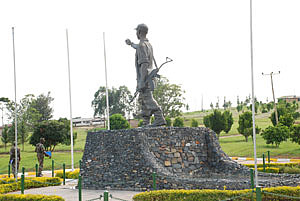
The Institute for Advanced Study and the Department of Art and Archaeology at Princeton University will mark their fifth collaboration on art history lectures in a series spanning the range of geography, time and ideas in art history. Among other topics, the 2012–13 lecture series will include examinations of gifts in Late Antiquity, Byzantium, and Early Islam; artists and memorialization in Uganda; and the reproduction of exhibitions in magazines after World War II.
The series was organized by Yve-Alain Bois, Professor in the School of Historical Studies at the Institute, and Nino Zchomelidse, Assistant Professor in the Department of Art and Archaeology at Princeton University.
“This year’s series is a little different than the preceding ones,” said Bois, “in the sense that we did not focus on a particular issue that would link the various talks together. We wanted both to take the temperature of the field, so to speak, and in doing so reveal its dynamism. As will become clear, the diversity of interests and approaches testifies to the vitality of art history in its present state.”
Past joint Institute for Advanced Study–Princeton University art history lecture series have focused on the sensuous in art, the spaces of art, and art’s relationship to its audiences.
The 2012–13 series will begin Tuesday, October 23, with “Recognition: Theme and Meta-Theme in Northern Renaissance Art” by Mitchell Merback, Associate Professor at Johns Hopkins University, beginning at 5:00 p.m. in Wolfensohn Hall at the Institute for Advanced Study.
The series will continue with the following talks:
November 14, 5:00 p.m. – 101 McCormick Hall, Princeton University
“The Empire of Things: Gifts and Gift Exchange in Late Antiquity, Byzantium, Early Islam, and Beyond”
Anthony Cutler, Pennsylvania State University
December 4, 5:00 p.m. – 106 McCormick Hall, Princeton University
“Impossible Design: Porsena's Tomb and French Visionary Architecture”
Erika Naginski, Harvard University
December 10, 5:00 p.m. – Wolfensohn Hall, Institute for Advanced Study
“Up Close and Far Away: Artists, Memorialization, and Uganda's Troubled Past”
Sidney Kasfir, Emory University
February 12, 2013, 5:00 p.m. – 106 McCormick Hall, Princeton University
“Family Matters: The Strange Case of the 'Poetic Ideas' Scroll Attributed to Mi Youren and Sima Huai”
Peter Sturman, University of California, Santa Barbara
March 5, 5:00 p.m. – Wolfensohn Hall, Institute for Advanced Study
“How to Occupy an Image”
David Joselit, Yale University
April 9, 5:00 p.m. – Wolfensohn Hall, Institute for Advanced Study
“The Ubiquitous Exhibition: Magazines, Museums, and the Reproducible Exhibition after World War II”
Olivier Lugon, Université de Lausanne
About the Department of Art and Archeology at Princeton University
The Department of Art and Archaeology at Princeton University, founded in 1883, has long been a leading center for the study of art, architecture and archaeology. Besides covering all periods of European art and architecture, current faculty members teach in areas as diverse as Chinese bronzes, pre-Columbian objects, Islamic art, Japanese prints, African art, American art, the history of photography and theory and criticism.
About Art History at the Institute
The history of art has been represented at the Institute since 1935, when Erwin Panofsky was appointed to the Faculty of what was then the School of Humanistic Studies. Formalized as the School of Historical Studies in 1949, the School has been home to some of the world's leading art historians, whose publications have become key references for generations of art historians. In addition to its permanent Faculty, each year the School hosts scholars from around the world who come to pursue their studies in a range of areas within art history. These scholars work alongside fellow Members specializing in the range of humanistic disciplines, from socioeconomic developments, political theory, and modern international relations, to the history of science, philosophy, music, and literature.
About the Institute for Advanced Study
The Institute for Advanced Study is one of the world’s leading centers for theoretical research and intellectual inquiry. The Institute exists to encourage and support curiosity-driven research in the sciences and humanities—the original, often speculative thinking that produces advances in knowledge that change the way we understand the world. Work at the Institute takes place in four Schools: Historical Studies, Mathematics, Natural Sciences and Social Science. It provides for the mentoring of scholars by a permanent Faculty of approximately 30, and it ensures the freedom to undertake research that will make significant contributions in any of the broad range of fields in the sciences and humanities studied at the Institute.
The Institute, founded in 1930, is a private, independent academic institution located in Princeton, New Jersey. Its more than 6,000 former Members hold positions of intellectual and scientific leadership throughout the academic world. Thirty-three Nobel Laureates and 40 out of 56 Fields Medalists, as well as many winners of the Wolf and MacArthur prizes, have been affiliated with the Institute.