Jonathan Israel to Discuss the “British Club” in Paris in Lecture at Institute for Advanced Study
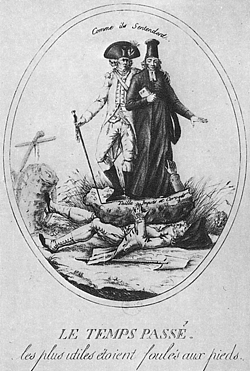
At the great banquet at the British Club in Paris held on November 18, 1792, more than a hundred distinguished Anglo-American democrats, including Tom Paine, David Williams, Joel Barlow, Eleazar Oswald, John Oswald, Helen Maria Williams and Lord Edward Fitzgerald, gathered to celebrate liberty, human rights and the spread of democracy across the world—what they viewed as the assured democratic future of mankind. Mary Wollstonecraft, who joined the group at the hotel soon after the banquet was held, and several other founders of modern feminism were an integral part of this movement. In “Celebrating Modern Democracy’s Beginning: The ‘British Club’ in Paris (1789–93),” Jonathan Israel, Professor in the School of Historical Studies at the Institute for Advanced Study, will explore the vast significance of the toasts drunk at this banquet and of the public address that was afterward presented to the French National Assembly. The lecture will take place Wednesday, March 7, at 4:30 p.m. in Wolfensohn Hall on the Institute campus.
Prior to the Terror (1793–94), the French Revolution was generally viewed very positively by American, British and Irish as well as German and Italian democrats and progressive constitutional thinkers and law reformers. One of the most impressive expressions of international enthusiasm for the universal values of human rights, equality, freedom of expression and democracy proclaimed by the early French Revolution (1789–93) were the gatherings of the “British Club,” an Anglo-American salon of supporters of democracy and human rights in Paris. The toasts of the great British Club banquet and the public address that followed illuminate the relationship between the French Revolution and modernity, the history of our own time and the many ironies of the values and propositions that the British Club in Paris proclaimed to the world.
Israel’s work is concerned with European and European colonial history from the Renaissance to the eighteenth century. His recent work focuses on the impact of radical thought (especially Spinoza, Bayle, Diderot and the eighteenth-century French materialists) on the Enlightenment and on the emergence of modern ideas of democracy, equality, toleration, freedom of the press and individual freedom. His most recent book, Democratic Enlightenment: Philosophy, Revolution, and Human Rights, 1750–1790 (Oxford University Press, 2011), argues that the Enlightenment was a revolutionary process driven by philosophical debate.
Israel studied at the University of Oxford, earning a D.Phil. in 1972. He served as Professor at University College London before joining the Faculty of the Institute in 2001. His work has been recognized with the Wolfson Literary Award for History (1986), the Leo Gershoy Award of the American Historical Association (2001), the Royal Netherlands Academy of Arts and Sciences’ Dr. A. H. Heineken Prize in History (2008) and the Benjamin Franklin Medal of the London Royal Society for the Encouragement of Arts, Manufactures and Commerce (2010). Israel is a fellow of the British Academy and a corresponding fellow of the Royal Netherlands Academy of Arts and Sciences. In 2004, he was named Knight of the Order of the Dutch Lion.
For further information about the lecture, which is free and open to the public, please call (609) 734-8175, or visit the Public Events page on the Institute website, www.ias.edu.
About the Institute for Advanced Study
The Institute for Advanced Study is one of the world’s leading centers for theoretical research and intellectual inquiry. The Institute exists to encourage and support curiosity-driven research in the sciences and humanities—the original, often speculative thinking that produces advances in knowledge that change the way we understand the world. Work at the Institute takes place in four Schools: Historical Studies, Mathematics, Natural Sciences and Social Science. It provides for the mentoring of scholars by a permanent Faculty of approximately 30, and it ensures the freedom to undertake research that will make significant contributions in any of the broad range of fields in the sciences and humanities studied at the Institute.
The Institute, founded in 1930, is a private, independent academic institution located in Princeton, New Jersey. Its more than 6,000 former Members hold positions of intellectual and scientific leadership throughout the academic world. Thirty-three Nobel Laureates and 40 out of 56 Fields Medalists, as well as many winners of the Wolf and MacArthur prizes, have been affiliated with the Institute.