Benedict H. Gross Appointed to Institute for Advanced Study Board of Trustees
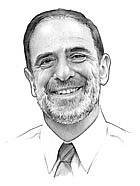
The Institute for Advanced Study has appointed Benedict H. Gross, the George Vasmer Leverett Professor of Mathematics at Harvard University, to its Board of Trustees, effective July 1, 2012. Gross, whose research is in number theory, was nominated by the Institute’s School of Mathematics. He will succeed Andrew J. Wiles, the James S. McDonnell Distinguished University Professor of Mathematics at Princeton University, who has served on the Institute’s Board since 2007.
Gross received his undergraduate degree from Harvard in 1971, a master’s degree from the University of Oxford in 1974, and his doctorate from Harvard in 1978. He served as Assistant Professor at Princeton University from 1978–82, Associate Professor at Brown University from 1982–85 and Professor at Harvard beginning in 1985. He was Dean for Undergraduate Education at Harvard from 2002–03 and Dean of Harvard College from 2003–07; in these positions he oversaw the first review of undergraduate education at Harvard in nearly 30 years.
The American Mathematical Society awarded Gross and his collaborators the Frank Nelson Cole Prize in Number Theory in 1987 for work on the L-functions of elliptic curves. Among other honors, he is the recipient of a MacArthur Fellowship and a member of the American Academy of Arts and Sciences and the National Academy of Sciences.
Gross is the author, with Joe Harris, of The Magic of Numbers (Prentice Hall, 2003), which introduces non-mathematicians to the mathematical mode of thought. A course on abstract algebra taught by Gross is available at www.extension.harvard.edu/open-learning-initiative/abstract-algebra.
About the Institute for Advanced Study
The Institute for Advanced Study is one of the world’s leading centers for theoretical research and intellectual inquiry. The Institute exists to encourage and support curiosity-driven research in the sciences and humanities—the original, often speculative thinking that produces advances in knowledge that change the way we understand the world. Work at the Institute takes place in four Schools: Historical Studies, Mathematics, Natural Sciences and Social Science. It provides for the mentoring of scholars by a permanent Faculty of approximately 30, and it ensures the freedom to undertake research that will make significant contributions in any of the broad range of fields in the sciences and humanities studied at the Institute.
The Institute, founded in 1930, is a private, independent academic institution located in Princeton, New Jersey. Its more than 6,000 former Members hold positions of intellectual and scientific leadership throughout the academic world. Thirty-three Nobel Laureates and 40 out of 56 Fields Medalists, as well as many winners of the Wolf and MacArthur prizes, have been affiliated with the Institute.