Glen Bowersock To Speak On "The Three Romes" In May
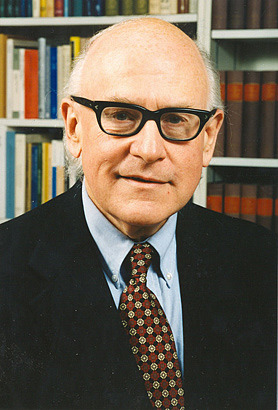
Leading Historian on Ancient History Retires After Twenty-Six Years at the Institute
Glen Bowersock, a preeminent authority on Greek, Roman, and Near Eastern history, will present "The Three Romes" on Friday, May 5, at 6:00 p.m. in Wolfensohn Hall on the campus of the Institute for Advanced Study. Dr. Bowersock is a Professor in the School of Historical Studies, and will be retiring after twenty-six years at the Institute on July 1, 2006.
In this presentation, Professor Bowersock will speak on the emergence and interrelated fates of Rome, Constantinople and Moscow. Rome became the capital of a great Mediterranean empire, which tried through myth and mystique to reconcile its legendary Trojan origins with its presence in Italy. As Roman power grew, the city's name became synonymous with the center of imperial government and, as Christianity grew, of ecclesiastical authority too. But when Constantine transferred the imperial capital to Byzantium and re-named the city after himself, Constantinople became a new or second Rome. For many centuries, this eastern Rome was both the capital of the Byzantine empire and the center of orthodox Christianity. It succumbed to the Ottoman Turks in 1453, and the Russians, who had accepted Christianity from the Byzantine Greeks, could then claim that Moscow had become the Third Rome. Professor Bowersock will discuss the implications of the triadic concept, and the lessons it has to teach us about our past and our present.
For further information about this event, which is free and open to the public, please call (609) 734-8175.
Twenty-Six Years at IAS
On July 1, 2006, Dr. Bowersock will become Professor Emeritus in the Institute's School of Historical Studies, after serving twenty-six years on the Faculty. Over the past four-and-a-half decades, Professor Bowersock has written or edited more than a dozen books and published some 300 articles on Greek, Roman and Near Eastern history and culture and the classical tradition in modern literature. His books include Greek Sophists in the Roman Empire (1969), Julian the Apostate (1978), Roman Arabia (1983), Fiction as History, from Nero to Julian (1994), Late Antiquity. A guide to the Postclassical World, ed. with Peter Brown and Oleg Grabar (1999) and Martyrdom and Rome (1995).
Professor Bowersock has received numerous awards in recognition of his scholarship and contributions to the field. In 2004, he was named a Chevalier, or Knight, of the Légion d'Honneur (Legion of Honor), an order of merit given by the French government. Instituted by Emperor Napoleon I in 1802, it is one of France's most prestigious awards and the country's highest civilian honor. In 1992, he was honored with the James Breasted Prize of the American Historical Association for his book Hellenism in Late Antiquity (1990).
He has been awarded honorary degrees from the University of Strasbourg, l'Ecole Pratique des Hautes Etudes and the University of Athens. Named an Honorary Fellow of Balliol College, Oxford University in 2004, Professor Bowersock is a Fellow of the American Academy of Arts and Sciences, Foreign Fellow of the Accademia Nazionale dei Lincei, Member of the American Philosophical Society, Member of the Académie des Inscriptions et Belles-Lettres and a Foreign Member of the Russian Academy of Sciences. He also serves on the Boards of Directors of the Metropolitan Opera and the Metropolitan Opera Guild.
Professor Bowersock received his A.B. from Harvard University in 1957, and after earning a B.A. and M.A. at Oxford University, he was awarded a D.Phil. from Oxford in 1962. He taught at Oxford in Balliol, Magdalen, and New Colleges from l960 to 1962, at which point he joined the faculty of Harvard. There, he was Professor of Classics and History, as well as Chairman of the Department of Classics from 1972 to 1977, and Associate Dean of the Faculty of Arts and Sciences from 1977 to 1980, at which time he joined the Faculty at the Institute. He was Visiting Professor at Oxford University in 1966 and at Australian National University in 1972. In 1991-92, he served as Sather Professor at the University of California at Berkeley, and was Visiting Professor at the Collège de France in 1997, where he gave four lectures and was presented with a medal.