A Conversation on "Scholar of Islam, Victim of the Holocaust: The Tragic Story of Hedwig Klein"
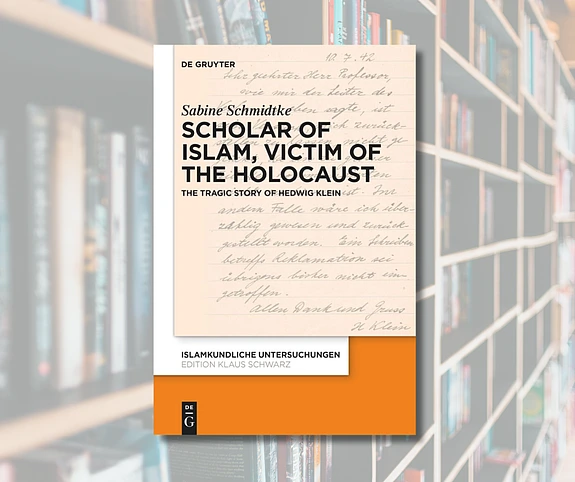
The following conversation focuses on Scholar of Islam, Victim of the Holocaust: The Tragic Story of Hedwig Klein (De Gruyter, 2026), a new book by Sabine Schmidtke, Professor of Near Eastern and Islamic Studies in the Institute for Advanced Study’s School of Historical Studies.
The book narrates the fascinating, powerful, and yet immensely tragic story of the life and career of Hedwig Klein, an exceptionally talented and potentially path-paving German Jewish scholar of Islam with a focus on Ibāḍī knowledge traditions. Klein was killed during the Holocaust in 1942 at the age of thirty-one.
In this book, Schmidtke performs three tasks simultaneously: providing an intimate social and intellectual history of German Orientalism and Islamic Studies at the cusp of and during Nazi Germany, presenting a finely grained analysis of Klein’s life and her intellectual contributions to Islamic Studies, and correcting some popular and dominant misconceptions about Klein’s role in the writing and compilation of the equally well-known and controversial scholar Hans Wehr’s widely used Arabic dictionary.
In many ways, the book brings together two prominent threads of Schmidtke’s recent scholarship: her work on Shī‘ī, Zaydī, and Ibāḍī knowledge traditions centered on the excavation and production of critical editions of previously lesser-known Arabic manuscripts and her long-running project of offering an in-depth intellectual genealogy of the German Orientalist tradition in Islamic Studies. Ultimately, the book not only restores a critical, silenced voice and expert of Islam but also reorients our prevailing conceptions of Orientalism while showcasing the impact of the Holocaust on the study of Islam today.
In what follows, questions are posed to Schmidtke by SherAli K. Tareen, Patricia Crone Member (2024–25) in the School of Historical Studies, who is himself an expert in Muslim intellectual traditions and debates in early modern and modern South Asia.

Sabine Schmidkte
Professor, School of Historical Studies
Sabine Schmidtke is a scholar of Islamic intellectual history whose pioneering research has transformed perspectives on the interrelations and connections among different strands of intellectual inquiry, across time, place, religions, and philosophical schools.

SherAli K. Tareen
Patricia Crone Member (2024–25), School of Historical Studies
SherAli K. Tareen is the author of the award-winning books Defending Muhammad in Modernity (2020) and Perilous Intimacies: Debating Hindu-Muslim Friendship after Empire (2023). He serves as Professor of Religious Studies at Franklin and Marshall College.
Who was Hedwig Klein, and what got you to write this book? Why is this particular book so important to you?
Hedwig Klein was born on February 19, 1911, in Antwerp, the second daughter of Abraham Wolf Klein and Recha Klein (née Meyer). She grew up in Hamburg in an orthodox Jewish household, living with her mother, her older sister Therese, and her maternal grandmother Gretchen at Parkallee 26 in the Eimsbüttel district. Her father had been reported missing on the Eastern Front during World War I and was officially declared dead in 1926.
She was a brilliant young scholar of Islam—an Arabist and philologist who studied at Hamburg University, where she majored in Islamic studies with minors in Semitic studies and English philology. She passed her doctoral exams on December 18, 1937, earning the highest possible grade in both her dissertation and oral examinations. But because she was Jewish, she was ultimately denied her doctoral degree under the Nazi race laws. On July 11, 1942, she was deported to Auschwitz, where she was murdered. She was just thirty-one years old.
What initially drew me to Hedwig Klein was the controversy surrounding her involvement with Hans Wehr’s famous Arabic dictionary and the dictionary’s supposed connection to an Arabic translation of Hitler’s Mein Kampf. Now, let me be clear: Klein was definitely involved in the preparatory phase of the dictionary—that is not in question. The question is how significant her contribution was in terms of quantity and what exactly her role was. The claim that has gained the most traction is that Klein was effectively the author of the dictionary, with Wehr merely putting his name on it. I was struck by the lack of documentation in the blog posts and essays making this claim, and by the absence of any attempt to situate Klein’s biography within a larger framework. When I began searching for relevant materials, it became what I describe as “an intriguing journey through a plethora of archival sources,” each providing important clues about aspects of Klein’s short life and her broader familial, social, and scholarly context.
Through my research, I was able to reconstruct the early history of the dictionary and analyze in detail who was involved and what they did. It turns out that Klein was one of roughly a dozen contributors extracting material from published sources, and she was involved for less than a year, from approximately September 1941 until the spring or early summer of 1942. Although the scholarly standard of her work was outstanding—consistent with everything she produced—the sheer volume of her contribution, given the short time frame, could not have been substantial. So the sensationalized narrative that Klein essentially created the dictionary is simply not supported by the evidence.
This book is deeply important to me for two distinct reasons. First, Klein’s tragic life story is a microhistory of a deeply troubled yet incredibly fascinating historical moment, one with major implications for the trajectory of Islamic studies in the twentieth century and to the present day. The Nazis’ rise to power in 1933 marked a turning point in the development of the discipline. It signaled the end of German scholars’ leadership in Arabic and Islamic studies, the end of German as the principal language of scholarship, and an internationalization that left the field very different from what it had been in the nineteenth and early twentieth centuries. Jewish scholars were forced into retirement, Jewish students were eventually barred from earning doctoral degrees, and a large number of Jewish scholars and students of Oriental studies were murdered during the Holocaust. Those who managed to leave were dispersed around the world—to Mandatory Palestine, the United States, England, France, Turkey—and not all of them found ways to continue their academic careers. Klein’s fate stands as a powerful reminder of the impact of the Holocaust on the production of knowledge about Islam, not just in Germany but globally.
Second, and separately, I felt a responsibility to set the historical record straight about Klein herself—to push back against the simplified, misleading accounts that ultimately do a disservice to Klein and to historical truth. She should be known for what she truly was—a scholar of exceptional ability, a meticulous philologist, and a person of extraordinary intellectual determination—not as a footnote in someone else’s story or as a vehicle for narratives that the archival evidence simply does not support.
Can you talk a bit about the political and intellectual scene at Hamburg University in the early 1930s when Klein was there?
When Hedwig Klein enrolled at Hamburg University in the summer semester of 1931, the Weimar Republic was still in place. Despite the negative consequences of the global economic crisis, the swelling political conflicts, and the rise of anti-Semitism, the environment still allowed her to focus on her studies. Things changed dramatically in early 1933, when she was halfway through her university studies.
Hamburg University is actually notorious for having implemented the Nazi racial ideology faster and more smoothly than most other German universities. About 20 percent of the faculty in the Faculty of Philosophy were forced out. Ernst Cassirer, the prominent philosopher and former rector, was one of the first to leave—he departed on March 12, 1933. Erwin Panofsky, the art historian, William Stern, the psychologist, and many others were expelled. Chairs in philosophy, art history, and psychology were replaced with chairs in things like “racial and cultural biology” and “colonial and overseas history.”
But Klein was somewhat shielded initially. The Seminar für Geschichte und Kultur des Vorderen Orients—the Oriental Studies department where she spent most of her time—was located away from the main university building, and its faculty kept their distance from the Nazis. Her teachers—Rudolf Strothmann, Arthur Schaade, Walter Windfuhr—were, as her fellow student Albert Dietrich later put it, “liberal, cosmopolitan people who were as far removed from anti-Semitic ideas as it was possible to be.” The robust presence of Middle Eastern students and lecturers at the department, including the Tunisian Arabist Tahir Khemiri and the Turkish scholar Necati Hüssni, may also have helped counter the influence of German politics on daily scholarly routines.
Klein’s non-Jewish fellow students—especially Albert Dietrich and Martin Abel—continued to treat her as a valued peer even after 1933. So, there was this strange bubble within the university where genuine scholarly collegiality persisted even as the world outside was becoming increasingly hostile and dangerous for Jews.
Yet the legislative assault was relentless—the boycotts, the Nuremberg Race Laws of 1935, the growing restrictions on Jewish students. The number of Jewish students at Hamburg plummeted from 151 in the summer of 1933 to just 58 by the following winter semester. And Klein saw, year by year, how her cousins, classmates, and teachers left Germany—some by choice, others out of sheer desperation.

Can you explain a bit the tradition of German Orientalist scholarship on Islam that Klein, her teachers, and her interlocutors were a part of that took seriously seemingly marginal or less dominant aspects of Islam, like Ibadism?
This is really central to understanding what made Klein’s work distinctive. Her principal teacher, Rudolf Strothmann, was particularly intrigued by the Ibāḍīs—a distinctive Muslim minority community that is the only surviving branch of Khārijism. Unlike the majority of German Islamicists of the time, Strothmann deliberately focused on manifestations of Islam outside the mainstream. He believed that studying these minority traditions would yield a less essentialized understanding of Islam and a more nuanced grasp of its inner diversity. This led him to study Zaydism, Twelver Shīʿism, Ismāʿīlism, and Ibāḍism.
Now, it’s important to understand that the study of Ibāḍism had been pursued since the mid-nineteenth century primarily by French, British, and Italian scholars—and this was not a coincidence. These scholars had access to the relevant source material because of their countries' colonial presence in regions that had been home to Ibāḍī communities since the eighth century: the Mzab valley in Algeria, the Jabal Nafūsa in northwestern Libya, the island of Djerba in Tunisia, and Oman in southeastern Arabia. The key figures—people like George Percy Badger and Edward Charles Ross—were mostly diplomats, colonial administrators, or military officers who happened to encounter these texts in the course of their professional duties. They were not primarily trained philologists or historians; they were working within a colonial context.
German scholars, by contrast, had no colonial background in any of these regions and therefore faced enormous difficulties in accessing Ibāḍī sources. The brief period of German control over Zanzibar did yield a few important textual sources—most notably those obtained by Eduard Sachau, who had a copy of the Kashf al-ghumma (Dispeller of Grief), the very work Klein would later edit and make the focus of her dissertation, transcribed in Zanzibar in 1895 and deposited at the Seminar für Orientalische Sprachen in Berlin. But that was essentially the extent of what German scholars could access directly.
Strothmann himself never had the opportunity to visit any Ibāḍī strongholds. He had to rely on the manuscript copies held in Berlin and on printed books published mostly in Cairo. He lamented these limitations, describing how the Ibāḍīs’ secretiveness made it very difficult for scholars to access their sources—how lithographs from the sultan’s printing house in Zanzibar, for example, carried warnings that books should never be given to anyone who was not “trustworthy,” and a non-Muslim was certainly not considered trustworthy.
So, what distinguished Strothmann and Klein from most of their predecessors and contemporaries working on Ibāḍism was that they were true philologists and historians who approached the material at hand professionally. They brought rigorous textual-critical methods to bear on these sources—the kind of deep philological engagement that was the hallmark of the German scholarly tradition. The British scholars who had dealt with Omani Ibadi texts before them were, for the most part, colonial officials who produced translations and summaries rather than critical editions. Klein’s dissertation—a meticulous critical edition with a full apparatus of variants, emendations, and historical annotations—represents a fundamentally different kind of scholarly engagement with the Ibāḍī textual tradition.
And Klein was not alone in this endeavor. She was one of three students of Strothmann whose dissertation topics concerned minority groups outside mainstream Sunni Islam—the others being the Egyptian Muḥammad Māḍī, who worked on Zaydism, and the Iraqi Jawād ʿAlī, who studied Twelver Shīʿism. So, there was a real programmatic vision behind this work—a conviction that understanding Islam in all its diversity required taking seriously the voices that had been marginalized or overlooked.
What was Klein’s dissertation about, and what were some of its distinctive features?
Klein’s dissertation was a critical, annotated edition of chapter 33 of the Kashf al-ghumma al-jāmiʿ li-akhbār al-umma (Dispeller of Grief that Assembles the Reports of the Community), a historiographical work compiled during the first half of the eighteenth century on the Ibāḍīs of Oman. This chapter covers the history of Oman from the beginning of Islam until 1728.
She actually started with a different project—she had planned to edit an anonymous history of Oman called al-Shuʿāʿ al-shāʾiʿ (The Prevailing Beam), a copy of which was listed in the catalog of Edward G. Browne’s manuscript collection in Cambridge. But when she examined a sample portion and compared it with other known sources, she concluded that its historical content was largely identical with already available material and that an edition wouldn’t yield new insights. So, she pivoted to the Kashf al-ghumma.
The main manuscript she worked from was the copy held by the Seminar für Orientalische Sprachen in Berlin. But this manuscript was replete with errors and lacunae, and producing a critical edition from it alone was impossible. Her efforts to find additional copies were futile. So, she developed an innovative methodological approach: she consulted several secondary witnesses—Ross’s partial translation from a different manuscript, Ibn Ruzayq’s al-Fatḥ al-mubīn (The Manifest Victory) from Cambridge, the al-Shuʿāʿ al-shāʾiʿ manuscript, and Nūr al-Dīn al-Sālimī’s Tuḥfat al-aʿyān bi-sīrat ahl ʿUmān (The Gift for the Nobles on the History of the People of Oman)—to establish the text.
The resulting edition was of superb quality. It includes a critical apparatus recording variants in the secondary sources and her emendations, as well as a second explanatory apparatus with detailed historical notes on persons, places, and contexts mentioned in the text. She also undertook a careful analysis of the question of the work’s authorship, which had been debated since Ross’s 1874 translation. Her methodological approach of consulting secondary sources to establish the text was later emulated by subsequent editors of the book.
Klein also discussed the work’s sources in detail, identifying texts such as the Kitāb Ansāb al-ʿArab (Book of the Genealogies of the Arabs) by al-ʿAwtabī and the Kitāb al-Siyar (Book of Biographies) by Abū Qaḥṭān—a demonstration of remarkable erudition for someone working with such limited access to materials.
Both Strothmann and Schaade rated the dissertation “ausgezeichnet” (excellent)—the top mark available. And both her dissertation and her contributions to the Arabic dictionary project demonstrate her erudition as a philologist and an Arabist, as well as her tireless dedication and her perfectionism.
How does her dissertation reach us? How was it preserved?
This is a poignant story with several layers. When Klein submitted her revised dissertation in November 1938, the influence of the Nazi race laws was already at work. The dean, Fritz Jäger, initially granted the imprimatur on November 30, 1938, but then retracted it on December 16 after consulting Kurt Niemann, an ardent Nazi supporter who had been appointed Hamburg’s director of higher education. Jäger told the printer J. J. Augustin that the work could be published only in a form that avoided any reference to its character as a doctoral dissertation—meaning a changed title page, deletion of the referees' names, and omission of the curriculum vitae.
Klein then asked J. J. Augustin to print just fifty “private” copies without the official university title page. These copies were apparently ready in early January 1939, and she immediately began distributing them—sending them to colleagues, potential employers, and scholars abroad who might help her emigrate. She gave signed copies to her fellow students, Albert Dietrich and Max Krause, and she also sent copies to scholars internationally.
Remarkably, Klein even sent copies of her dissertation to the two Ibāḍī sultans of the time—Saʿīd b. Taymūr, the Sultan of Muscat and Oman, and Khalīfa b. Ḥārub al-Būsaʿīdī, the Sultan of Zanzibar. This was facilitated by Rudolph Said-Ruete, a German-British intermediary with family connections to the Busaidi royal house. And she received letters of confirmation from both sultans acknowledging receipt of her work.
After the war, it was Carl A. Rathjens—a Hamburg geographer and Yemen specialist who had known Klein and her teachers—who took it upon himself to ensure her dissertation would be properly recognized. In 1947, the philosophical faculty of Hamburg University voted to grant Klein a posthumous doctoral degree, and Rathjens arranged for the dissertation to be officially published and distributed to libraries and scholars worldwide. The doctoral certificate was issued on August 15, 1947—five years after her murder in Auschwitz.
What is important to emphasize is that Klein’s dissertation was widely known from the very beginning and was widely cited—not only by scholars in the West, such as Carl Brockelmann in the second edition of his Geschichte der arabischen Literatur (GAL), but also by Ibāḍī scholars themselves. It became a standard reference in the field of Ibāḍī studies, and it has remained so for decades. This is a testament to both the quality of her work and the efforts of those who ensured its dissemination after her death.
And here is something else that makes her edition not just a scholarly achievement but an irreplaceable piece of textual preservation: the Berlin manuscript of the Kashf al-ghumma that Klein had used as her primary source was destroyed in an air raid on Berlin on February 3, 1945, along with the entire library of the Seminar für Orientalische Sprachen. This means that Klein’s dissertation is literally the only surviving witness to the manuscript she worked on. So in a very real sense, her meticulous philological work saved something from oblivion—even as the world around her was conspiring to consign her and her work to oblivion.


What is the nature of the controversy surrounding Klein’s contribution to the famous German philologist Hans Wehr’s dictionary of Arabic? What position does your book offer on this matter that corrects some of the major misconceptions on this topic?
Since 2014, several blogs and online essays have focused on Klein’s involvement with what became Hans Wehr’s Arabisches Wörterbuch für die Schriftsprache der Gegenwart and have claimed that the dictionary project was connected to efforts to produce an authorized Arabic translation of Hitler’s Mein Kampf. This narrative has generated considerable attention and an outpouring of shorter essays and blog posts.
My book demonstrates that there is, in fact, no connection between the two projects. The claim is based on a misreading of a 1938 letter by Werner Otto von Hentig, the head of the German Foreign Office’s Orient desk. What von Hentig actually did in that letter was ask the Foreign Office library to procure the dictionaries he listed—he was simply requesting that existing reference works be added to the library’s collection. However, later interpreters read this letter as von Hentig lamenting the lack of an Arabic-German dictionary. This misreading is the principal reason why the two projects—the dictionary and the Mein Kampf translation—became conflated in the eyes of the essayists who have written about this since the early 2000s. In reality, the dictionary project was a legitimate scholarly undertaking with a long prehistory in Western Arabic lexicography, whereas the Mein Kampf translation effort was a propaganda project. The two had nothing to do with each other.
I also need to correct the record about the extent of Klein’s contribution. Now, as I said earlier, Klein was definitely involved in the preparatory phase of the dictionary—that is not in question. What matters is the scale of her actual contribution and the nature of the role she played. The often-repeated claim is that she, in fact, did the dictionary, whereas Wehr simply published it as his own. Through my research, I was able to reconstruct the early history of the dictionary, analyze in detail who was involved, and trace each participant's contributions. It turns out that Klein worked on the project only from approximately September 1941 until the spring or early summer of 1942, and that another ten to twelve people were extracting material from published sources just as she did. While the quality of her contribution was superb—as was everything she touched—in terms of quantity, it cannot have been much.
My correction to this dominant narrative is not meant to downplay the difficulties Klein faced in her work on the dictionary, nor to endorse wholesale the way she was treated in the process. And let me be clear: I have no stake in defending Hans Wehr’s reputation, though the evidence shows that the charge of Nazi sympathies leveled against him is in fact unfounded. Rather, my intention is to set the historical record straight and counter the misleading narratives that, above all, are unfair to Klein’s legacy.
The true story—of a young Jewish scholar of extraordinary gifts who kept doing rigorous scholarly work even as her world was collapsing around her—is far more compelling than any distorted version could ever be.
What is your hope in terms of what you would like readers to take away from this book, especially regarding the impact of the Holocaust on the academic study of Islam?
I hope readers will understand that Klein’s tragic life story illuminates something much larger than one individual’s fate. It is a window into how the Holocaust fundamentally reshaped the production of knowledge about Islam—not just in Germany but globally. The seizure of power in 1933 shattered the field’s institutional foundations. The Holocaust erased an entire generation of Jewish scholars—people who were actively contributing to the study of Islam, Semitic languages, and the cultures of the Middle East. Some perished in the camps. Others were driven into exile across the globe, and many never found a way back to academic life. The collective loss of their knowledge, their expertise, their ongoing research projects, and the scholarly networks they had built is incalculable. German dominance of the discipline came to an abrupt end, German ceased to be the lingua franca of scholarship, and the field was transformed beyond recognition.
Klein’s story makes this abstract history concrete and human. Here was a woman of extraordinary talent and dedication—someone who received the highest possible grades from her examiners, whose work was of such quality that it remains a reference point in Ibāḍī studies decades later—and she was murdered at thirty-one because she was Jewish.
I also hope this book serves as a corrective to the sensationalism that has surrounded Klein’s story in recent years. She deserves to be remembered for who she actually was—a gifted scholar, a dedicated philologist, a woman of remarkable intellectual courage—not as a prop in a sensationalized narrative, but as the extraordinary person and scholar she was in her own right.
And finally, I hope the book honors the many people who tried to help her—Strothmann, Schaade, Said-Ruete, Rathjens, and many others—even when their efforts ultimately failed. Their humanity in the face of an inhuman system is part of this story too.
As Margot Friedländer, the Holocaust survivor whose words I chose as the epigraph for this book, has said: “Seid Menschen!”—“Be human!” That is perhaps the most important thing any reader can take away.