Friends Dinner with Chris Hamilton
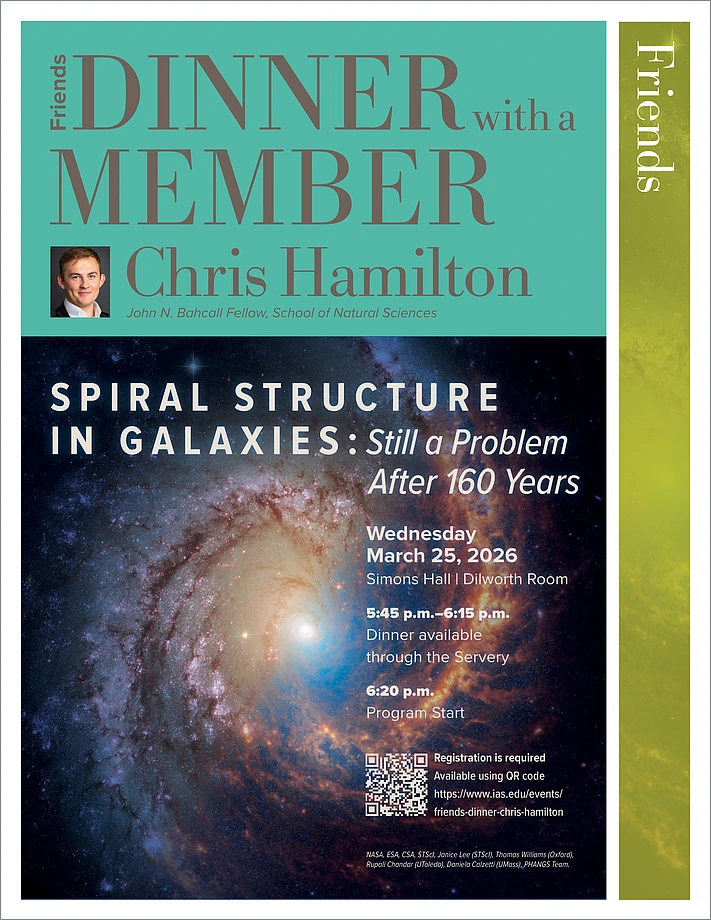
Friends Dinner

Spiral Structure in Galaxies: Still a Problem After 160 Years
Friends Dinner with Chris Hamilton
Wednesday, March 25, 2026
Simons Hall | Dilworth Room
5:45 p.m.–6:15 p.m. | Dinner available through the Servery
6:20 p.m. | Program Start

Spiral structure is one of the most beautiful and striking aspects of galaxies like the Milky Way. It has fascinated astronomers and astrophysicists since the first spiral arms were discovered by William Parsons, third Earl of Rosse, in 1845. Yet–more than 160 years later–we still have only a partial understanding of why spirals arise, how long they live, and what they are really telling us about galaxies, gravity, and dark matter. In this talk Chris Hamilton, John N. Bahcall Fellow in the School of Natural Sciences, will discuss the current state of the field in spiral galaxy observations with the James Webb Space Telescope. He will then introduce the paradigmatic theories that were developed in the 1960s to explain spiral behavior but remain contested today. Finally, Chris will discuss recent work that unifies many of these theories into a single mathematical framework, and speculate on what the next few years—or indeed the next 160—might bring.

To learn more about Chris Hamilton's work, visit his IAS scholar page.

Register below to attend.

Registration Form

Friends Dinner with a Member - March 25, 2026

IAS Affiliation
RSVP
Please register your additional attendee(s) here
more items

Date & Time

March 25, 2026 | 6:00pm
Add to calendar 03/25/2026 18:00 Friends Dinner with Chris Hamilton use-title More: https://www.ias.edu/events/friends-dinner-chris-hamilton   _SPIRAL STRUCTURE IN GALAXIES: STILL A PROBLEM AFTER 160 YEARS_ FRIENDS DINNER WITH CHRIS HAMILTON WEDNESDAY, MARCH 25, 2026 SIMONS HALL | DILWORTH ROOM 5:45 P.M.–6:15 P.M. | DINNER AVAILABLE THROUGH THE SERVERY 6:20 P.M. | PROGRAM START Spiral structure is one of the most beautiful and striking aspects of galaxies like the Milky Way. It has fascinated astronomers and astrophysicists since the first spiral arms were discovered by William Parsons, third Earl of Rosse, in 1845. Yet–more than 160 years later–we still have only a partial understanding of why spirals arise, how long they live, and what they are really telling us about galaxies, gravity, and dark matter. In this talk Chris Hamilton, John N. Bahcall Fellow in the School of Natural Sciences, will discuss the current state of the field in spiral galaxy observations with the James Webb Space Telescope. He will then introduce the paradigmatic theories that were developed in the 1960s to explain spiral behavior but remain contested today. Finally, Chris will discuss recent work that unifies many of these theories into a single mathematical framework, and speculate on what the next few years—or indeed the next 160—might bring. To learn more about Chris Hamilton's work, visit his IAS scholar page. [https://www.ias.edu/scholars/chris-hamilton] Register below to attend. Dilworth Room a7a99c3d46944b65a08073518d638c23

Location

Dilworth Room

Categories