 |
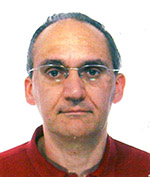
Wendi Adamek
In residence for: Year
Office: W104 Extension: 8161 Email: wadamek@ias.edu
Home Institution: University of Calgary
Research Field: Chinese Buddhism
Project Title: Nirvana as Permanence, Joy, Self, and Purity in a Medieval Chinese Buddhist Commentary
Research Abstract: The aim of this study is to examine a localized Chinese context for the development of tathagatagarbha (buddha matrix)-influenced soteriology, through the lens of the Nirvana-sutra characterization of nirvana as permanence, joy, self, and purity (chang le wo jing). The sixth-century Dasheng yi zhang (Chapters on the Meaning of the Mahayana) provides an important window into the hermeneutics through which the rubric chang le wo jing was understood and adapted by clerics of the Northern dynasties. The Dasheng yi zhang is attributed to Huiyuan (523- 592) of Jingying temple in Chang'an. Huiyuan was one of the most prominent masters active in the Northern Qi, Northern Zhou, and Sui dynasties, and his work shows a synthesis of two of the "Treatise" schools, the Dilun and Shelun. I propose to use the evocative rubric of chang le wo jing to explore theories of buddha-nature and buddha-bodies in Huiyuan's important commentary and his intellectual milieu, as yet relatively little-studied in Western-language scholarship. Working intratextually, I hope to elucidate the significance of this rubric within a network of associated concepts. Working intertextually, I will draw on studies linking different kinds of texts, including stelae, memorial and votive inscriptions, liturgies and verse, and the more traditional repertoire of scriptures, hagiographies, commentaries, and catalogues. I intend to approach this topic and its instantiations not only as important historical and cultural artifacts, but as part of ongoing investigation into the nature of agency and efficacy.
|
 |
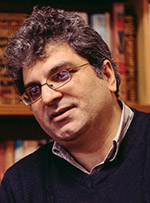
Gianfranco Agosti
In residence for: Second Term
Office: W226 Extension: 8345 Email: gagosti@ias.edu
Home Institution: Sapienza Università di Roma
Research Field: Greek Epigrams in Late Antiquity
Project Title:Greek Metrical Inscriptions of Late Antiquity: Society and Culture in the Mediterranean World
Research Abstract: This project is part of a long-term research I have been working on for many years, aiming at producing a monograph devoted to a comprehensive study of the social and cultural role of inscriptional Greek poetry in Late Antiquity (end of the 3rd to the beginning of the 7th c. AD). Central issues of the monograph (for which I completed all the preliminary stages of research) are a re-evaluation of inscriptional poems as literature; their social role as vehicles of display and diffusion of learning, both in the form of traditional paideia and of the new Christian culture; a re-consideration of verse inscriptions' place in the urban space of Late Antique Eastern Mediterranean cities. In the first part of my monograph, I aim to offer a re-assessment of literary aspects of Late inscriptions. In the second part I will deal with the relationship between school and epigraphic production, analyzing the influence of school education on Late Roman society as reflected in the written display. The third part will be devoted to a crucial problem, i.e. that of audience's response to inscriptions, studying the oral performance and the ‘reenactment' of the inscribed poems in order to stimulate audience's reactions. The fourth part of the book will deal with religious transformation and the creation of new modalities of cultural identity. The issue is the role played by verse inscriptions in changing classical paideia and in Christianizing Late Antique cities. I will analyze Christian inscriptional poems from 4th century onwards, which appear to be increasingly influenced by Christian poets (as Gregory of Nazianzus or Nonnus), trying to find their place in the complex strategy of communication typical of the multicultural milieu of Late Antique communities. |
 |
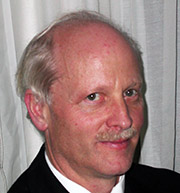
Hassan Farhang Ansari
In residence for: Year
Office: B203 Extension: 8322 Email: afarhang1349@ias.edu
Home Institution: Institute for Advanced Study
Research Field: Intellectual and Legal Studies
Project Title: A New Source on Zaidī scholarship in Northern Iran (in collaboration with S. Schmidtke)
Research Abstract: From the 9th through the late 12th century, the leading intellectual centres of Zaidism were located in Northern Iran, namely in Ṭabaristān, Daylamān and Gīlān in the Caspian region, as well as in Rayy during and after the Buwayhid age and in Bayhaq in Khurāsān. Gradually, the Zaidī communities in Iran experienced a decline and most of their literary legacy was no longer transmitted. Had it not been for the massive transfer of Zaidī religious literature from Iran to Yemen following the political unification of the Caspian and Yemeni Zaydīs that began by the end of the 11th century, most of the Iranian Zaydī literary heritage would have been lost. Following the death in 1217 of the Yemenite Imam al-Manṣūr bi-llāh, during whose reign the cultural transfer from Iran to Yemen reached its peak, relations between the Iranian and Yemenite Zaidī communities became more tenuous and the transfer of literary sources from Iran to Yemen which had by now replaced Northern Iran as the intellectual center of Zaidism had mostly ceased. That the tradition of Zaidī learning continued in Iran at least until the 16th century is confirmed by scattered documents attesting the scholarly tradition of Zaidism of the 15th and 16th centuries, as well as by a number of manuscripts transcribed in the Caspian Zaidī community between the 13th and the 16th centuries. A particularly important source containing rich information on the scholarly tradition of Iranian Zaidism up until the 16th century is a work complex that departs from the legal judgments (fatāwā) of Zaidī imam al-Nāṣir li-l-ḥaqq al-Ḥasan b. ʿAlī al-Uṭrūsh (d. 917). These have been collected and arranged according to the established rubrics of fiqh works by Muḥammad b. Yaʿqūb al-Hawsamī al-Nāṣirī al-Qāḍī (d. 1063) in the Kitāb al-Ibāna fī l-fiqh, a work that became the most significant text for the legal tradition of the Nāṣiriyya branch of Zaidism (named as such after its eponym al-Nāṣir li-l-ḥaqq al-Uṭrūsh) and served as point of departure for an entire genre of commentaries, supercommentaries and glosses among the Zaidīs of Northern Iran. Shams al-Dīn Muḥammad b. Ṣāliḥ al-Jīlānī, one of the leading representatives of the Nāṣiriyya during the 13th century, has made an attempt to collect all those different commentaries and glosses and to incorporate them in a structured manner into his own supercommentary (Sharḥ al-Ibāna/ Zawāʾid al-Ibāna). The envisioned in depth study of Muḥammad b. Ṣāliḥ’s super commentary will shed for the first time light on the dimensions of Zaidī scholarship in Iran between the 10th and the 15th centuries.
|
 |
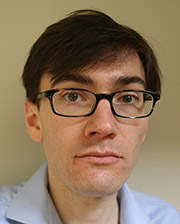
Jeffrey Barash
In residence for: Year
Office: W110 Extension: 8007 Email: jabarash@ias.edu
Home Institution: Université de Picardie, Faculté de Sciences Humaines
Research Field: History of Political Thought
Project Title: Political Myth and its Modern Transformations
Research Abstract: My project concerns the genesis and historical transformations of political myth in its specifically modern forms. According to my principal hypothesis, the significance of modern myths in a Western context may best be set in relief in historical relation to the public authority of the Judeo-Christian tradition. This relation changes, and with it the character of myth itself, where the absolute status and transcendent reference of religion are brought into question. Over a long historical period, this transformation corresponds to the emergence of increasingly human-centered belief systems and the widespread assumption that religion is partially or wholly composed of mythical elements that are of human origin. If this historical development has often been characterized as a movement toward secularization and "disenchantment of the world", my study will focus on the corresponding quest for "re-enchantment" that this movement fuels and which, in an increasingly human-centered universe, sets the context for the emergence of specifically modern forms of political mythology. In my study, three principal factors will contribute to the elucidation of the novel significance of modern myth and the political role that it came to play: transformations of attitudes toward pagan myth from the 16th to the mid-19th centuries, changes in assumptions concerning the relation between the Old and New Testaments and the absolute status of the traditional corpus, and the quest, beginning in late 19th century, for re-enchantment in the sharply modified public sphere of emergent mass societies. In our contemporary public sphere dominated by the integration of markets and the global reach of the mass media, set in a context where the symbolic configuration of information increasingly depends on the image and the culture of the image, an elucidation of the plastic character of myth and of its political articulations throughout the modern period promises to contribute to an understanding of the unique significance and ongoing potency of myth in our times.
|
 |
Marisa Bass
In residence for: Year
Office: F312 Extension: 8339 Email: mbass@ias.edu
Home Institution: Washington University in St. Louis
Research Field: Renaissance Art
Project Title: Encrypted Knowledge: The Art of Joris Hoefnagel in the Wake of the Dutch Revolt
Research Abstract: The destruction and dispersal attendant to war has compelled artists and scholars across history to engage in urgent archival preservation. The sixteenth-century Netherlandish artist Joris Hoefnagel, whose career was forged during the violent upheaval and inquisition of the Dutch Revolt, is one such example. My book manuscript centers on Hoefnagel’s major encyclopedic project, an exhaustive four-volume manuscript of animals and insects, which has been celebrated in past scholarship for its painterly virtuosity and precocious empiricism. Yet these volumes are not wholly what they seem. A catalogue of lived experience underlies Hoefnagel’s engagement with natural history in the aftermath of the Revolt. I argue that natural images, and the complex epistemic structure of these volumes, allowed Hoefnagel to comment on contemporary human events through carefully concealed means and to dialogue with an intimate circle of friends who shared in his wartime experience. |
 |
Sarah Bassett
In residence for: Year
Office: F320 Extension: 8315 Email: bassett@ias.edu
Home Institution: Indiana University
Research Field: Late roman and Byzantine Art
Project Title: Style and Meaning in the Late Antique Visual Art
Research Abstract: It is commonly accepted that Roman art in the period between the first century and the sixth follows a stylistic trajectory that moves from "naturalism" to "abstraction", and that this shift corresponds to a rejection of rational thought in favor of spiritual experience. I am applying to complete work on a book manuscript, which challenges this paradigm. I do so by following two paths of inquiry. In the first, I examine the development of the reigning interpretive formula in the context of nineteenth-century modernist thought, noting the ways in which developments in the study of optics, psychology, and art history shaped and eventually defined the approach to late antique art in an academic context. I also consider the importance of modernist art and aesthetics together with the role played by the nineteenth-century fascination with occult and spiritualist practice. In the second path, I argue that late antique art needs a contemporary language of evaluation. In the absence of any surviving late antique visual theory, I look to sources pertinent to music, poetry, and rhetoric to define that language. Finally, I use this new vocabulary to examine individual works of art such as imperial portraits, Christian icons, and narrative representations to demonstrate the new types of understanding to emerge from this approach. |
 |
Joshua Billings
In residence for: Second Term
Office: W217 Extension: 8362 Email: jbillings@ias.edu
Home Institution: Princeton University
Research Field: Classics
Project Title: Representation on stage
Research Abstract: My project investigates Greek drama and philosophical thought at the end of the fifth century BCE. It focuses on concepts of representation, understood as the relation between reality and forms of perceiving or conveying it, among them the senses, language, and works of art. Philosophical and cultural developments at this time cast new doubt on the ability of various forms of representation to convey truth, and Attic tragedy and comedy, I argue, take part in this contestation. Drama, as a form of representation itself, presents questions of truth and falsehood in a distinctive fashion, and especially from around 415, is engaged in thinking through its own illusory quality. I see the project centering on a few conceptual constellations in late fifth-century thought: a group concerned with perception and imitation, a group related to deception and lies, and a group focused on questions of wisdom and civic order. Through close reading and contextual reconstruction of the contemporary intellectual field, the project will seek to show drama in dialogue with philosophy, rhetoric, and historiography, illuminating canonical works through an engagement with philosophical questions. |
 |
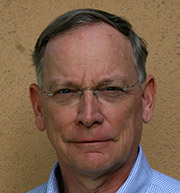
Thomas Biskup
(Gerda Henkel Member)
In residence for: Year
Office: W210 Extension: 8282 Email: tbiskup@ias.edu
Home Institution: University of Hull
Research Field: Political history, history of science
Project Title: Multi-national empires of knowledge: practices of natural history in Anglo-German networks 1735-1800
Research Abstract: Situated at the crossroads of political history and history of science, the project examines how in the field of natural history, a global web of cross-border exchanges and dependencies emerged that linked Germany, Britain, and its colonies in the second half of the 18th century. In the second half of the 18th century, natural historians from Britain and Germany formed closely-knit networks to explore the extra-European world. On the basis in particular of the Anglo-Hanoverian personal union, they confronted the logistical as well as epistemological challenges European expansion in the Americas, Africa and Asia posed for natural historians. On a "high-speed" link established between England and North Germany, they exchanged texts, objects, and staff and collaborated on projects, such as overseas expeditions. For the first time, the project systematically analyses the interdependencies of Britain and Germany in a scholarly field that was crucial for the exploitation of European territories and colonies as well as for debates about nature as a well-ordered system, a "great chain of being", in which man's exact place needed to be determined. In this period, natural history underwent dramatic changes, but the new taxonomic systems that shape our view of "nature" until today were themselves linked to imperial projects. The rise of Britain as Europe's biggest extra-European colonial empire impacted on the dynamics of scholarly relations in later 18th-century Europe, and by analyzing transnational exchange within Europe, this project aims to illuminate Britain's European interconnections in the area of knowledge production, which have been neglected by Atlantic History. Identifying important institutions, individuals, and switch points of scholarly exchange, the project examines how the "special relationship" Protestant North Germany and England had within the European republic of letters functioned, and discusses the specificity of knowledge-production in the British Empire through a comparison with Sweden's Baltic Empire. |
 |
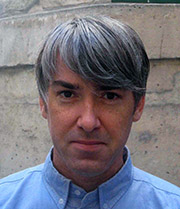
Mark Evan Bonds
In residence for: Year
Office: A110 Extension: 4566 Email: mebonds@ias.edu
Home Institution: University of North Carolina at Chapel Hill
Research Field: Aesthetics and Philosophy of Music
Project Title: Music as Autobiography
Research Abstract: Precisely because it lacks words or visible images, music has always been perceived as an ideal venue for the expression of emotions. But whose emotions? Western responses to this question have changed radically and more than once since the eighteenth century. Enlightenment critics and composers thought of expression as the objective representation of an emotion or series of emotions, crafted in such a way as to evoke a calculated response in listeners. The belief that a composition might reflect its creator's own personal emotions or innermost self was an assumption that did not take hold until the 1830s, driven by a convergence of philosophical, cultural, technological, and economic changes. New conceptions of the self, the rising prestige of the emotions, and the growth of a mass-market music culture, all combined to foster the perception of music as a form of emotional autobiography. By interpreting difficult new works as the outpourings of a unique individuality, listeners were able to gain access to increasingly diverse and challenging idioms. Composers, in turn, encouraged this attitude by advocating an aesthetic of subjectivity in their strategies of self-promotion and in their own writings on music. But in the early decades of the twentieth century, this aesthetic collapsed almost as quickly as it had begun: many leading composers and critics returned to an outlook that openly acknowledged artistic expression — and art in general — as an artifice. This renewed conception of expression as a detached, rational construct became a key element of modernist aesthetics, from the "New Objectivity" of the 1920s through the high modernism of mid-century. The perception of a musical work as a manifestation of its composer's innermost emotional life has nevertheless proven remarkably resilient: even when acknowledged as a useful fiction, the notion of life-as-works and works-as-life retains a powerful hold on the Western imagination. My project is a 120,000-word monograph that traces, for the first time in any language, the changing concept of music as an expression of the self. |
 |
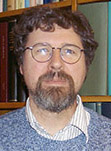
Courtney Booker
In residence for: Year
Office: F301 Extension: 8192 Email: cbooker@ias.edu
Home Institution: University of British Columbia
Research Field: Carolingian History, History of Drama
Project Title: Phantoms of Performance: History, Drama, and the Carolingian Pursuit of Truth
Research Abstract: What did references to drama mean to those who made them in the early Middle Ages? My project, "Phantoms of Performance: History, Drama, and the Carolingian Pursuit of Truth," attempts to answer this question by exploring the proliferation of allusions to drama under the Carolingians, and developing its rather significant implications with respect to medieval historiography, hermeneutics, and notions of the self. I contend that the sum of this early medieval textual evidence — despite its unreliability as evidence of actual theatrical performance — stands as a powerful and revealing statement about Carolingian culture: Drama and actors were constantly, if but allegorically, on the minds of many among the literate and learned. Consequently, some early medieval intellectuals occasionally read events (particularly misfortunes) through a synthetic and complex interpretive lens — one informed not only by Scripture but also by the ancient dramatic modes of tragedy and comedy. Theater may no longer have been performed in the early Middle Ages, but it continued to exert a strong influence upon the minds of the clergy who repeatedly claimed to abhor it. In explicitly characterizing Christ's Passion, the execution of John the Baptist, or the public penance of Charlemagne's son as each having been a "tragoedia," early medieval authors and exegetes revealed the extent to which drama permeated their thinking. It is my contention that, in alloying with other interpretive modes, drama not only acted to constrain and prescribe such thinking along certain paths, but opened new roads to the truth as well. |
 |
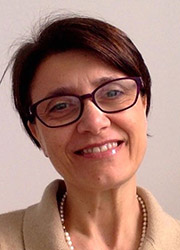
Stephen Burnett
In residence for: Year
Office: W203 Extension: 8321 Email: sburnett@ias.edu
Home Institution: University of Nebraska Lincoln
Research Field: Early Modern Jewish History
Project Title: Luther's Final Foes Anti-Semitism and Identity in Luther's 1543 Campaign against the Jews
Research Abstract: Martin Luther's attitude toward Jews and Judaism has been the subject of intense scholarly examination from many disciplinary perspectives. Luther's three polemical treatises — On the Jews and their Lies, On the Ineffable Name, and On the Last Words of David — all published in 1543, have proved difficult to understand within the context of Luther's career and Jewish history. I plan to write a book focusing on the overall arguments of these books, directed not only against German Jews but also against "Judaizers," Protestants who agreed with Jews on some issues. Linking Luther's extensive biblical discussions (about 70% of these books) with his anti-Jewish rants and political demands, I will trace his argument and clarify his purpose for writing these books. I will demonstrate that Luther's self-appointed tasks included drawing clear boundaries between Christianity and Judaism, distinguishing Lutheran biblical exegesis from that of its Protestant rivals, and warning German Protestant political leaders, clergymen, and the "Judaizers" of the dangers posed by Jews and Judaism. I am particularly interested in exploring whether Luther intended the books to be part of a larger "campaign" against the Jews. |
 |
Daniela Caglioti
In residence for: First Term
Office: W214 Extension: 8347 Email: dcaglioti@ias.edu
Home Institution: Università di Napoli Federico II
Research Field: Modern European History
Project Title: War and citizenship. Enemy aliens and the redrawing of the boundaries of citizenship in World War I and its aftermath
Research Abstract: The main aims of the proposed research project are 1. Contributing to the literature on the changing notion of citizen and citizenship between the turn of the 19th century and the aftermath of WWI; 2. Adding a chapter to the history of involvement of civilians in the war; 3. Analyzing the population policies toward groups defined in terms of nationality or ethnicity; 4. Exploring the role played by economic nationalism in reshaping demographic and migration policies and property rights. Adopting a comparative and transnational approach, the research and the book I plan to write focus on the social, political, cultural and juridical construction of enemy aliens and their treatment in Europe and Northern America during WWI and in its aftermath, on the process of convergence and divergence in the policies and their implementation, on the cross-fertilization and transfers between different legal cultures. |
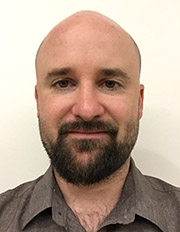 |
Matthew Canepa
In residence for: Second Term
Office: F311 Extension: 8326 Email: mpcanepa@ias.edu
Home Institution: University of Minnesota
Research Field: Ancient Iranian Art and Archaeology
Project Title: Royal Glory, Divine Fortune and the Iranian Expanse: Visual and Spatial Cultures of Kingship in Iran between Alexander and Islam
Research Abstract: I am submitting this proposal to advance a large-scale, multi-volume research project on the development of the visual cultures and spatial environments of power in Iran between Alexander and Islam (ca. 330 BCE – ca. 650 CE). The first volume, entitled The Iranian Expanse, focuses on problems of royal architecture, urbanism, landscape and cultural memory. It examines the role of the natural and built environment in shaping Iranian memory as well as the development of key institutions of Iranian royal landscapes and architecture: rock reliefs, sanctuaries, palaces and paradise gardens. The second volume analyzes the royal image in Iran after Alexander. It explores how competing Hellenic and Iranian royal cultures and identities clashed, fused and transformed in regions such as Pontos, the Balkans, Bosporos, Armenia, Mesopotamia, Iran, and Bactria, eventually yielding the visual culture of power of late antiquity. The geographical and chronological scope of these books encompass the great empires that ruled over the Iranian plateau and Mesopotamia as well as smaller kingdoms that were their clients or short-lived rivals in Anatolia, the Caucasus and Mesopotamia. Thus they consider the empires of the Seleucids, Arsacids and Sasanians as well as former Iranian satrapal dynasties of Anatolia and the Caucasus, such as the Mithradatids and Orontids. The first volume has been substantially drafted. The second volume is currently developing and will be the main focus of the fellowship period. |
 |
Janet Chen
In residence for: Year
Office: W107 Extension: 8164 Email: jychen@ias.edu
Home Institution: Princeton University
Research Field: History of Modern China
Project Title: The Sounds of Mandarin: The Making of a National Language in China and Taiwan, 1900-1960
Research Abstract: How did ordinary people learn to speak Mandarin in China? What constituted the language we call Mandarin at its various stages of historical formation, and how did it become a meaningful part of people’s lives? These questions are the inspiration for The Sounds of Mandarin, a project that investigates the creation of the national language in China and Taiwan at the turn of the twentieth century. By charting its fate as a social and cultural process, rather than the endpoint in the journey to linguistic unity, my research challenges the assumption that “Mandarin” was born whole at the time of its creation. The goal of this book is to reconsider how the idea and multiple realities of a national language intersected with the lives of ordinary people. |
 |
Wen-Shing Chou
In residence for: Year
Office: F313 Extension: 8271 Email: wchou@ias.edu
Home Institution: Hunter College, City University of New York
Research Field: Buddhist Art and Architecture
Project Title: Land of Transcultural Visions: Mount Wutai in the Making of the Qing Empire
Research Abstract: During the Qing Dynasty (1644-1912), China's premier Buddhist sacred mountain range of Wutai, located in Shanxi province in northeastern China, emerged as a shared site of pilgrimage among the multi-ethnic constituents of a rapidly expanding empire. Mount Wutai had developed into a major monastic center and attracted pilgrims from all over Buddhist Asia since the Tang dynasty (618-907). Tibetan Buddhist monasteries were first established on Mount Wutai when China was under Mongol rule in the late thirteenth century. But it was not until the Qing dynasty, under the ardent support of the Manchu emperors, that Mount Wutai became a thriving center of Tibetan Buddhism populated by monks, pilgrims, and patrons of Manchu, Mongol, Tibetan, and Han-Chinese origins. The common focus of all of their visits is in the phenomenon of revelatory visions: Mount Wutai's resident deity Mañjuśrī was (and still is) believed to make regular appearances in various guises. By examining an array of representations and reenactments of these visions, my project reconstructs the complex religio-political landscape of Mount Wutai during the Qing; I study materials across multiple visual traditions and linguistic registers—including icons of miraculous apparitions, replicas of holy temples, pilgrimage guides, eulogies, hagiographic narratives, and panoramic maps; they collectively mediate what proved to be a lively and ever-shifting reality of Mount Wutai in ways that physical, empirical, economic or historical data could not reveal. The analyses of these materials illuminate the dynamic agency of a diverse set of intermediary objects through which a palimpsest-like world of visions can be delineated. Moreover, as materials produced within a devotional context, they also helped to redefine political, ethnic, and religious identities for the Manchu emperors and their Tibetan, Mongolian and Han-Chinese constituents. |
 |
Albrecht Diem
In residence for: Year
Office: F302 Extension: 8158 Email: adiem@ias.edu
Home Institution: Syracuse University
Research Field: Medieval Monastic Studies
Project Title: Norm and Community: Early Medieval Monastic Rules and the Development of Regular Observance
Research Abstract: This project investigates the role of normative texts in organizing and ordering closed communities and shaping collective identities. It focuses on the development of western monasticism between the 5th and 9th centuries and particularly on the corpus of roughly 30 monastic rules produced in this period. I investigate when and how monastic communities began to organize themselves on the basis of written collections of norms and which notions of community and techniques of discipline these texts deployed. My goals are to write a history of regular observance, which challenges the notion that following a written rule was a stable feature of monastic life, and to provide a comprehensive study of all preserved early medieval monastic rules from Gaul and the Frankish kingdoms — many of which have never been studied. |
 |
Carolyn Eichner
In residence for: Year
Office: W112 Extension: 8114 Email: eichner@ias.edu
Home Institution: University of Wisconsin, Milwaukee
Research Field: Women/Gender in Modern Europe & Empire
Project Title: The Name: Legitimacy, Identity, and Gendered Citizenship in France and Empire
Research Abstract: Names form a site of engagement between people and states, colony and metropole, autonomy and hegemony, custom and law, and tradition and modernity. My book The Name: Legitimacy, Identity, and Gendered Citizenship in France and Empire will analyze the political, social, and cultural evolution of this most public representation of personal identity. Focusing primarily on the 19th century, it will examine the origins, rise, and implementation of naming controls in both metropole and colony. France used names to reify categories of inclusion and exclusion as it developed as a modern, imperializing state. Denominative parameters affected citizenship, legitimacy, and status, while also shaping legacies, histories, and identities. Examining the protocols and practices of naming reveals an increasingly tight web of hierarchy, hegemony, and domination through the period. These measures, which emerged as gendered, raced, religious, and class- based, exemplify the ideological and political evolution of the state as it increased its reach into metropolitan citizens and colonial subjects' lives. The Name looks specifically at the following populations, probing the ways in which individuals and groups navigated these incursions: women (subjected to, and sometimes challenged, the dominance of patrilineality and the degradation of the matronym), aristocrats (responded to shifting political factors by initially dropping the elite nominal particle "de" and later officially requesting its reinstatement), Jews (reacted to state assimilative measures demanding they adopt fixed monikers), and colonial subjects (defended traditional denominative practices in the face of governmental opposition). Centered on France and its empire, my study includes a transnational and comparative analysis of the history, meaning, and significance of naming practices in a broader European framework. The name itself serves as a metonym for these historical modes of power and resistance. My project will elucidate relations between state and populace, while expanding our understandings of citizenship, religion, marriage, legitimacy, gender, race, class, and empire. |
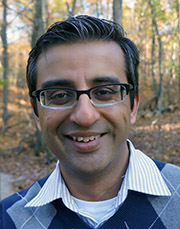 |
Nahyan Fancy
In residence for: First Term
Office: B200 Extension: 8361 Email: nfancy@ias.edu
Home Institution: DePauw University
Research Field: Premodern Islamic Science and Medicine
Project Title: In Ibn al-Nafis's Shadow: Medical Thought and Practice in Islamicate Societies during the Mamluk Period (1260-1518)
Research Abstract: The project will undertake a detailed examination for the first time of the theoretical and practical sections of eleven medical commentaries produced during this period in Islamic societies. Such an investigation will help scholars define the main contours of medical thought and practice during a period often mischaracterized as one of "decline," and thus duly ignored by medical historians. More importantly, the project will situate the medical debates and discussions within the intellectual, institutional and social contexts of these societies. In doing so, it will revolutionize the way historians of Islamic medicine have traditionally approached the study of the medical texts, and so provide greater insights into the place of medicine in pre-modern Islamic societies. |
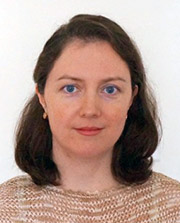 |
Rozaliya Garipova
In residence for: First Term
Office: B204 Extension: 8346 Email: garipova@ias.edu
Home Institution: University of Pennsylvania
Research Field: Islamic History
Project Title: Shari'a in the Russian Empire: Transforming the Muslim Community
Research Abstract: I am analyzing the impacts of the bureaucratization on Muslim institutions, Islamic law and religious practices in the Muslim communities of the Volga-Ural region of the Russian Empire in the nineteenth and early twentieth centuries. I claim that the efforts of Russian state to control the Muslim religious institutions and practices and the Muslims responses to these state policies had and still has a transformative impact on religion, religious institutions, religious practices and morality. Analysis of the dynamics of this transformation is crucial to understand the historical and contemporary relationship between the Russian state and Muslim minorities. |
 |
Eric Goldberg
In residence for: Year
Office: F303 Extension: 8272 Email: egoldber@ias.edu
Home Institution: Massachusetts Institute of Technology
Research Field: Early Medieval Europe, Late Antiquity
Project Title: With Practice, Skill, and Cunning: Hunting and Identity in Frankish Europe, AD 400-987
Research Abstract: My book project, "With Practice, Skill, and Cunning: Hunting and Identity in Frankish Europe, AD 400-987," explores the vital role of hunting in the creation of status, identity, and power in early medieval Europe. The chronological scope of the book spans the twilight of Roman rule in the West, through the Merovingian and Carolingian eras, up to the death of the last Carolingian king — in a hunting accident — in 987. Although hunting was a defining activity of early medieval elites, there has been no major study of the topic since Kurt Lindner's classic yet now outdated "Die Jagd im früen Mittelalter" (1940). The reason for this neglect is the false impression that hunting in the Frankish world was somehow primitive and lacking the courtly ritual, treatises, and artistic representations found in later eras. My book explores how hunting practices changed over time in the post-Roman West and gradually became integral to aristocratic power, secular manhood, Frankish identity, and Carolingian kingship. I argue that the Frankish culture of hunting and falconry reached a highpoint in the ninth century through a combination of Roman and Merovingian tradition, Carolingian innovation, and the heretofore overlooked influence of the ‘Abbasid court in Baghdad. To accomplish this, my study employs an interdisciplinary approach that combines the study of political, cultural, social, and environmental history and mines a wide range of sources including texts, manuscripts, visual arts, and archaeology. In short, "With Practice, Skill, and Cunning: Hunting and Identity in Frankish Europe, AD 400-987" uncovers the dynamic roles of the hunt in the formation of elite identity, court culture, and royal and aristocratic power in the foundational half millennium of Europe's history. |
 |
Bryna Goodman
In residence for: Second Term
Office: W103 Extension: 8333 Email: bgoodman@ias.edu
Home Institution: University of Oregon
Research Field: Modern Chinese History
Project Title: Finance and the New Chinese Republic: Capitalism, Sovereignty, and Freedom
Research Abstract: "Finance and the New Chinese Republic" examines Chinese understandings of economics, nationalism, and culture from the moment of the first translations of Western economic theory, at the turn of the twentieth century, to the Shanghai stock exchange bubble of 1921-1922 and its aftermath. The study maps political conjuncture (the new republic), urban space (co-existence of foreign enclaves and areas of Chinese jurisdiction), and the history of ideas (elite and vernacular). This book project uses the writings of Chinese economists, archives of financial institutions, exchange laws, legal cases, reportage, advertisements and a trove of exchange fiction, a hitherto untapped literary genre that emerged at the time of the Shanghai bubble. These materials illuminate the translation of finance capitalism, in theory and practice, into Chinese culture and society. In addition to tracing a shift from more liberal understandings of economics toward preoccupation with modeling a state-centered "national economics," or "controlled economics" in the aftermath of the bubble, the book shows how economic information, ideas of finance, and new political and financial institutions took shape in everyday consciousness. |
 |
Margaret Graves
In residence for: Year
Office: F321 Extension: 8160 Email: mgraves@ias.edu
Home Institution: Indiana University, Bloomington
Research Field: History of Islamic Art
Project Title: Small Worlds: Architecture, Scale and the Medieval Islamic Art of the Object
Research Abstract: This project investigates the use of architectural forms amongst small-scale, three-dimensional objects from the medieval Islamic world, using this material to explore the neglected role of the intellect in the decorative arts. The use of architecture as ornament, a striking mode of decoration that was widespread amongst utilitarian objects in the medieval Middle East, frequently resulted in functional objects that either assume the form of miniature buildings or allude more obliquely to architectural structures. As primarily mid-status objects of use, many of the materials under study have been given scant consideration to date as artworks when they have been studied at all, and the cultural significance of their decoration has been largely ignored until now. By considering the ‘architecturalized’ object as a meaningful artistic phenomenon that can illuminate the social, cultural, economic and artistic functions of both architecture and objects in the medieval Islamic urban context, the project returns intellectual agency to the medieval creators and consumers of these decorative artworks. At heart the project is concerned with the possibilities and limits of visual communication through objects; accordingly, the book develops a conceptual framework involving themes of ornament, representation, perception and scale that are of significance to historians of art, architecture and material culture broadly conceived, not just those within the sub-field of Islamic art history. |
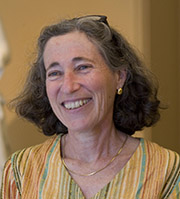 |
Christine Guth
In residence for: First Term
Office: W101 Extension: 8177 Email: cmeguth48@ias.edu
Home Institution: Royal College of Art
Research Field: Material Culture and Design History
Project Title: Materials making and meaning in early modern Japan
Research Abstract: My research focus is materials, making, and meaning in early modern Japan (1600-1868). I wish to explore the ways that the meanings of things were constructed in dynamic relationship to the physical properties of materials and changing technologies taking as starting point questions about the divergent and often gendered ways that material culture was experienced and understood by makers and users of differing professional and social backgrounds, in urban as well as rural settings. The issues to be addressed include changing attitudes towards materials and materiality, the standardization of production in lacquer, ceramics, textiles, and other media, the dissemination of technological knowledge, and consumption practices. |
 |
Najam Haider
In residence for: Second Term
Office: B200 Extension: 8361 Email: nhaider@ias.edu
Home Institution: Barnard College of Columbia University
Research Field: Islamic Studies
Project Title: Rhetoric, Sectarianism, and Early Islamic Historiography
Research Abstract: A central debate in Islamic studies over the last half century has centered on the question of veracity versus fiction in early Muslim historical texts. Julie Meisami rejects the very premises of this debate and instead proposes a new analytic approach that emphasizes the links between Islamic historical writing and the Classical rhetorical tradition. In Meisami's view, Muslim historians depicted events whose broad parameters were well-known in a rhetorical manner, making them relevant to contemporaneous circumstances. This maneuver was understood and accepted by an audience that perceived historical writing as rhetorical in nature and accepted a degree of narrative flexibility. My book project applies (for the first time) a rhetorical framework to the large corpus of early Muslim historical texts. My case studies draw on a wider breadth of sources than Meisami (who limits her work to a small set of sources/events) and incorporate a greater diversity of genres than Michael Cooperson (who focuses almost exclusively on biographies). The overall project will make two primary contributions to the field of Islamic historical studies. The first involves an analytic reorientation that pivots away from debates over veracity or fiction and towards a rhetorical understanding of early Muslim historical writing. The second centers on widespread assumptions about the unreliable, thoroughly "hagiographic" nature of Shī‘ī historical writing. If one employs a rhetorical approach, it becomes clear that Shī‘ī historians were adhering to the same general rules of historical writing that inform non-Shī‘ī sources. Similarly to my other work, this historiographical project counters assumptions about the outlier status of Shī‘īsm in the broader intellectual milieu of the pre-modern and modern Muslim world. |
 |
Julia Hairston
In residence for: Second Term
Office: W214 Extension: 8347 Email: jlhairston@ias.edu
Home Institution: University of California, Rome
Research Field: Early Modern Italian Literature
Project Title: Tullia d'Aragona, Woman of Letters
Research Abstract: Tullia d'Aragona was a celebrated sixteenth-century Italian courtesan and writer. Although Roman by birth, d'Aragona traversed numerous cultural centers of Renaissance Italy—not just Rome, Florence, and Venice, but also Siena and Ferrara. She participated in the political, literary, and musical coteries of each city, making friends and foes as an educated, cultured woman who moved in powerful circles. D'Aragona styled herself as the “intellectual courtesan" and left a copious, diverse body of work. D'Aragona participated on both sides of the French and Spanish struggle for Italy by fostering one papal candidate over another or by intervening in Sienese political uprisings. Her dialogue ‘On the Infinity of Love’ and chivalric epic ‘The Wretch’ not only figure among the earliest examples of those genres by a woman author, but also contribute to contemporary cultural debates about the ethics of fame, the role of the body in the creation of knowledge, and the relation of Islam to the Christian west. D'Aragona was extolled for her “divine intellect," in the words of Bernardo Tasso, glorified in madrigals by Philippe Verdelot, lauded as an excellent singer and lutist, and possibly painted by Sebastiano del Piombo. Yet perhaps in reaction to her celebrity status, literati such as Pietro Aretino and Agnolo Firenzuola attacked her in print and made her the subject of vicious satire. Her status and role as courtesan ultimately enabled her promotion as writer. My intellectual biography of her draws on extensive archival research conducted in Italy over the past eleven years that has yielded new information about her social origins as well as previously unknown poems that ground d'Aragona wholly within the context of sixteenth-century Italian culture and history. |
 |
Matthew Hopper
In residence for: First Term
Office: W218 Extension: 8358 Email: mshopper@ias.edu
Home Institution: California Polytechnic State University, San Luis Obispo
Research Field: African History
Project Title: Liberated Africans in the Indian Ocean World
Research Abstract: This project explores the lives of Africans liberated on the high seas of the Indian Ocean in the nineteenth century. The British Royal Navy seized thousands of captive Africans from ships in the Indian Ocean, most between 1858 and 1896, and relocated them to Christian mission stations and port cities around Britain's Indian Ocean empire. But the celebrated antislavery campaign also had tragic consequences. The vulnerability and mortality of liberated Africans challenge conventional notions of freedom and offer lessons for contemporary antislavery. Employing archival research in missionary and state records, this book project will examine communities of liberated Africans from Bombay to Cape Town to illustrate the complexities of abolition in the Indian Ocean. |
 |
Paulin Ismard
In residence for: Year
Office: W220 Extension: 8358 Email: paulinismard@ias.edu
Home Institution: University Paris 1 Pantheon Sorbonne
Research Field: Ancient Greek History
Project Title: The Greek Law of Slavery
Research Abstract: My research project consists in the study of all the legal aspects related to the question of chattel slavery in the Greek cities of Classical and Hellenistic periods. Such a project implies the acknowledgement of the renewal in the studies on slavery that have been carried out over the past thirty years in various disciplinary fields. Whether Africanists or specialists of the Asian world, many historians and anthropologists have highlighted the great diversity of slavery structures. Though they have had only a slight echo among historians of the Greek world, these works have renewed the conceptual categories in which slave societies used to be apprehended. The legal approach to the question of slavery, both regarding the analysis of legal categories and the “social uses of law”, has come to impose itself at the center of such new research. I am firmly convinced that our understanding of Greek slavery would greatly gain from an analysis carried out from a legal perspective. Our goal is firstly to analyze, in the light of literary sources and epigraphy, the legal definition of slaves according to the categories that organized Greek legal thought. It also intends to study the procedures involving slaves in the law of Greek cities, and the subsequent examination of the exact roles they were given therein, as witnesses, and sometimes as litigants. Furthermore, the economic role of slaves shall be at the heart of our analysis: the collaboration between slaves and citizens in some such activities implied that a degree of autonomy be imparted to slaves, which explains how certain forms of “commercial law” appeared, along with specific legal instruments, and concurrently with the patrimonial link of statutory subordination between slave and master. One might lastly observe how the legal relationships between cities were altered by the development of chattel slavery and the crucial issue represented by both the flight of slaves and the seizure of citizens. Finally, these research directions shed a new light on the question of the plurality of servile statuses, thus revealing the great complexity of Greek civic societies of the Classical and Hellenistic periods. |
 |
Willem Jongman
In residence for: First Term
Office: W226 Extension: 8345 Email: wjongman@ias.edu
Home Institution: University of Groningen
Research Field: Roman History and Economic History
Project Title: The grandeur that was Rome
Research Abstract: This project will extend and consolidate my research of the last decade on Roman economic performance into a book. The modern orthodoxy has been a pessimistic one: the vast majority of the Empire's population lived at or near subsistence, and this never changed. However, the large amounts of archaeological data that have become available in recent years show that this static reconstruction is wrong, at least for the last two centuries BC or so, and the first two centuries AD. Population increased dramatically, and so did production and consumption (both aggregate and more importantly per capita), to decline equally dramatically later on. The project will integrate such aggregate archaeological data on population, production, distribution, consumption and standard of living into a coherent economic analysis, and investigate possible causes. I thus want to re-introduce the Roman case into debates on world economic history from which it has long been absent. |
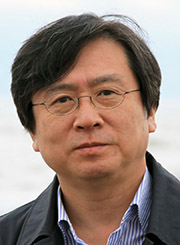 |
Hodong Kim
In residence for: Year
Office: W105 Extension: 8162 Email: hodongkim@ias.edu
Home Institution: Seoul National University
Research Field: History of the Mongol Empire
Project Title: The Mongol imperial institutions and the unity of the empire
Research Abstract: My research will be centered around the following questions. (1) How did the Mongol empire implement various political, military, and social institutions that were rooted in the Mongols' steppe tradition, which pre-dated their founding of the world empire? (2) How did these institutions evolved and transformed into something adapted to different sedentary traditions? (3) What were the difference and the similarity in these regionally modified institutions? (4) And finally, how did these institutions contribute to the preservation of the Mongol imperial unity? To answer these questions I would like to select, among others, four imperial institutions, which were continuously developed and modified by regional Chinggisid polities and were also adopted and subsequently replaced by non-Mongol states after the empire's demise. These are the ulus (Chinggisid domain), ordu (princely camp), darughachi (supervising governor), and jam (relay post). The ulus system was the most fundamental structural principle of the Mongol empire, and it is crucial to study the entire process of its evolution. The ordu, accompanied by keshig (royal guards), was the nucleus of imperial power. Chinggisid rulers constantly made seasonal migration with their ordus, and it was not only their dwelling place but also the place of political discussion and decision. The institution of darugha or darughachi, also known as basqaq or shahna in the western regions, was one of the most important means of the Mongol rule over the sedentary regions. And finally the network of jam was an indispensible means for the facilitation of the communication and exchanges of people and commodities. All these four institutions were originated in the steppe; the Mongols did not borrow them from China or Iran. Nonetheless, they were important means of Mongol rule over Eurasia and crucial elements for the understanding of their empire. I expect that the study of these Mongol imperial institutions would make us reflect on the traditional view of the ‘dissolution' of the empire into the four khanates and give us a new perspective on the unity of the empire. |
 |
Michael Kulikowski
In residence for: Year
Office: W219 Extension: 8359 Email: mkulikow@ias.edu
Home Institution: Pennsylvania State University
Research Field: Late Antiquity/Early Middle Ages
Project Title: Mosaics of Time: The Latin Chronicle Tradition
Research Abstract: The ancient and medieval chronicle genre is much studied but not always well understood, in part because various subdisciplines define the genre in idiosyncratic ways that do not take into account its long development, from the Ancient Near East, through the Classical and Hellenistic Greek worlds, to the later Roman empire and thence the central Middle Ages in both Latin West and Byzantine East. The ancient Latin chronicle tradition forms just one part of this larger story and is the focus of Mosaics of Time, Volume 2, the second of four volumes on the Latin chronicle and its various subgenres (volume 1, which appeared in 2013, was a historical survey of the larger genre, from ancient Mesopotamia to Sigebert of Gembloux, ca. 1100). Mosaics Vol. 2 focuses on the indigenous Latin tradition of consularia (i.e., expanded consular fasti, lists of the annual pair of senior magistrates long used for dating purposes but expanded with historical notations). For some periods of Roman history these consularia represent the sole explicit evidence for chronology and are often the best evidence for the sequence of events. This volume presents new critical editions, translations, and historical commentaries on the whole consularia tradition. Later volumes will cover another Latin chronicle tradition, twice calqued on Greek models, in the first century BC and again in the fourth century AD, that eventually subsumed the native consularia form. The editions and commentary in Volume 2 will have two main effects: first, they will illustrate the generic continuity between the late Republican and early imperial consularia preserved epigraphically and the late and post-imperial consularia preserved in manuscript; secondly, the new textual and historical criticism on the late antique consularia, which improve on Theodor Mommsen's standard editions of the 1890s, show that what have hitherto looked like chronologies securely attested by multiple sources are in fact based on lone archetype (or hyparchetype) sources. That, in turn, affects our understanding of both absolute and relative chronologies in late antiquity, and in the fifth-century West in particular. |
 |
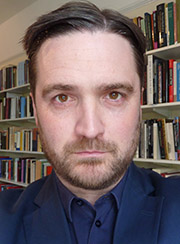
Michael Kunichika
In residence for: Year
Office: F322 Extension: 8338 Email: mkunichika@ias.edu
Home Institution: New York University
Research Field: Russian and Soviet Culture
Project Title: Archaeology and the Twilight of Utopia
Research Abstract: Why did late socialism rediscover the archaic? This project seeks to answer that question by taking an interdisciplinary approach that combines the histories of archaeology, cinema, and literature. It examines the discursive claims in which archaeologies found in the territory of the Soviet Union were embedded, and the representational forms in which Soviet audiences confronted the deep past. The central claim of this study is that the archaic formed an alternative source for a universal story of man that located its sources of value in the deep past, rather than in the stagnating present of "really existing socialism." It further argues that archaeology, as both a practice, theme, and conceptual model, served as a proxy to grapple with the experience of Stalinism, and with the promise of, and disenchantment with socialist culture. |
 |
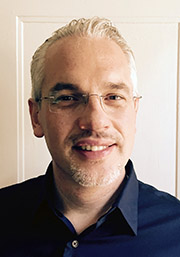
Rhodri Lewis
In residence for: Year
Office: W209 Extension: 8317 Email: rlewis@ias.edu
Home Institution: University of Oxford
Research Field: Literary and Intellectual History
Project Title: Francis Bacon's Early Philosophical Writings
Research Abstract: Volume 5 of the Oxford University Press edition of Francis Bacon's works (hereafter OFB 5) comprises Bacon's early philosophical writings to ca. 1611; principally, the "Valerius Terminus", the "Cogitata et visa", the "Redargutio philosophiarum", and the “De sapientia veterum”. There are a number of other fragments. None of these texts (other than the “De sapientia”) was published in Bacon's lifetime, all but two of them are written in dense Latin, and each of them (again, with the exception of the “De sapientia”) is hard to date with any certainty. Such difficulty and inaccessibility has caused them to be overlooked by modern scholars — an oversight that has, in its turn, contributed to an appreciation of Bacon's ideas and intellectual persona that is partial and misleading. OFB 5 puts this right. It establishes, translates, and annotates these texts for the first time, making them available to all early modernists, as well as to historians of science and philosophy. In so doing, it demonstrates that these texts are vital to a full understanding of (i) Bacon's programme for the reform of knowledge, and (ii) the richly interpenetrative relationship between philosophical, scientific, and more broadly humanistic patterns of thought that underpinned much early modern writing. Furthermore, it demands that we recalibrate our notions of Bacon, of his place within early modern intellectual culture, and of what "Baconianism" might be said to represent. Just as importantly, it embodies and encourages an awareness that authors like Bacon (whatever they might have come to signify within specific national or learned traditions) must be approached through cross-disciplinary and multi-linguistic methodologies if they are fully to be understood. I am the editor of OFB 5, and have already established each of the texts. For the duration of the academic year 2015-16, I will be on statutory sabbatical leave, and will use the time to complete my remaining tasks: translation, commentary, and introductory matter. I am applying for one year's IAS membership in support of this work, and can think of no better place in which successfully to wrap things up. |
 |
Eugenio Menegon
In residence for: First Term
Office: W103 Extension: 8333 Email: emenegon@ias.edu
Home Institution: Boston University
Research Field: Late Imperial China
Project Title: Amicitia Palatina: Court Networks and the Europeans in Imperial Beijing
Research Abstract: This is a proposal to complete a book manuscript based on four years of archival research (2010-2014) in China and Europe. 'Amicitia Palatina' investigates the more intimate and hidden dimensions of the staging of power during the reign of the Qianlong Emperor (1735-1799) in China, by focusing on the Catholic missionaries working as scientists and artists in Beijing. The study highlights how these Europeans, in spite of their subservient positions within the palace personnel, continued to pursue their religious interests, used their technical skills to gain patronage, and covertly challenged bureaucratic control and autocratic hegemony. Drawing on Chinese and European manuscript sources, I examine issues of domination, resistance, and political networking. The book situates the discussion of Qing political culture and European presence at court within on-going debates on the tension between autocracy and bureaucratization in China, and the role of dynastic households in Europe and Asia (1500-1900). |
 |
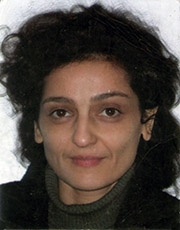
Jason Moralee
In residence for: Year
Office: F304 Extension: 8173 Email: jmoralee@ias.edu
Home Institution: University of Massachusetts, Amherst
Research Field: Late Antiquity
Project Title: Capitol after Empire: The Capitoline Hill from Late Antiquity to the Middle Ages
Research Abstract: This book-length project investigates the multiple receptions of Rome's Capitoline Hill (modern Campidoglio), from the third to the twelfth century CE. It is the first study to pay sustained attention to the receptions of the Capitol from the end of the Roman empire to the reinvention of the hill in the twelfth century as the commune of the city. The book provides a re-examination of the available literary evidence, incorporates the understudied gesta of the Roman martyrs and other legendary materials, evaluates the archaeological findings on and around the hill from the last two hundred years, and presents new evidence for the persistence of classical structures into the fifteenth century. Finally, it teaches us that the Capitol of memory bequeathed to the west as a secularized political center was born not in the Roman republic, but rather in late antiquity. The IAS fellowship will allow me the time and resources to complete and revise the six substantive chapters of the book and a lengthy appendix consisting of an introduction and translation of a Latin text. It will also allow me to draft anew and revise the book's introduction and conclusion. At the end of the fellowship, I will be able to submit the polished manuscript for publication. |
 |
Negin Nabavi
In residence for: Second Term
Office: B204 Extension: 8346 Email: nnabavi@ias.edu
Home Institution: Montclair State University
Research Field: Modern Iranian History
Project Title: Debating Modernity: The Emergence of Publics and Public Spheres in the Late Nineteenth and Early Twentieth Century Iran
Research Abstract: This book project addresses the much-neglected topic of the emergence and shaping of publics and public spheres in the late nineteenth and early twentieth century Iran. It is a study of a range of public spaces that emerged in Iran as part of an unfolding modernity between the 1870s and the 1920s, a fifty-or-so year period which has generally been recognized as having been a time of transformation in Iran. This study, however, argues that the emergence and shaping of a public sphere, in the sense of a space where broader publics could interact and discuss issues of common and shared interest constituted an important part of the developments of this period. It, therefore, focuses on five key spaces, namely the press, coffee-houses, reading rooms, women's associations, and secret societies/political associations, emphasizing the varied nature of the public spaces that existed in Iran during this period. By considering how these spaces came to be and changed over time, this study explores the role that they played in both the making of publics and the engagement of the marginalized and common people in a newly-emerging political and civic discourse. This study ultimately hopes to provide a new perspective on the experience that Iran had with modernity. |
 |
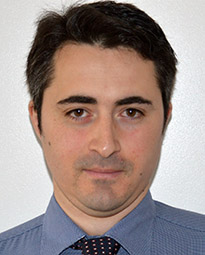
Martti Nissinen
In residence for: Second Term
Office: W216 Extension: 8356 Email: mnissine@ias.edu
Home Institution: University of Helsinki
Research Field: Assyriology, Biblical Studies
Project Title: Westeners in Assyria: A Case Study of modus vivendi in the Ancient Near East
Research Abstract: Assyria was the dominant power in the ancient Near East in 9th-7th centuries BCE, spreading its political, commercial, and cultural hegemony to the West. At the same time, it was receptive to cultural influences from West to the extent that the traditional Babylonian-Assyrian culture was thoroughly infiltrated by Western cultural elements, including the Aramaic language which gradually replaced Akkadian. While there is an increasing number of studies on the Assyrians in the West, not much has been written on the Westeners in Assyria; with "Westeners" I mean Arameans, Phoenicians, Israelites and Judeans, and other people coming from the areas governed by Assyria in Syria and the Levant. The objective of my research is to contribute to a comprehensive view of the socio-cultural and demographic changes in the Near East by studying the social, political, economic, and religious role of the Western population in the Assyrian mainland in the Neo-Assyrian period. The outcome of the project will be a comprehensive picture of the role of Western population in Assyria within the framework of the ethnic composition of Mesopotamia. It will be shown that Westeners, especially the Arameans, formed the biggest and culturally most significant non-Assyrian group, having access to any occupation in the Assyrian society, including the highest positions in the state bureaucracy and a full assimilation into the upper crust of the society. "Westeners in Assyria" can be presented as a historical analogy to the modern situation as an example of modus vivendi between populations coming from different backgrounds. |
 |
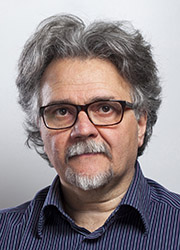
Giuseppe Pezzini
In residence for: Second Term
Office: W224 Extension: 8363 Email: gpezzini@ias.edu
Home Institution: University of Oxford
Research Field: Latin Literature
Project Title: Edition of and Commentary on Terence's Heauton Timorumenos
Research Abstract: I aim to prepare the first modern edition of and full-scale commentary on the Self-Tormentor (Heautontimorumenos) of Terence, for centuries one of the most widely read Latin authors. His position in Latin cultural history is remarkable and his work constitutes an early attempt at linguistic standardisation and the creation of a literary language. Scholars to date have been discouraged from this challenging task because of the complexities of the play, ranging from its complex textual tradition to its apparently intricate plot. The comedy contains one of the most brilliant character portrayals in ancient literature, Chremes, and some wonderfully comic dialogue, as well as raising perennially relevant questions, such as those about relations between fathers and sons. In the discussion of literary and dramatic issues raised by this brilliant and neglected play, the text will be central: I will prepare a new edition, based on a fresh examination of the main manuscripts, and in the commentary I will pay particular attention to metre and language, as starting points for broader discussion. |
 |
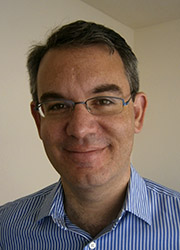
Andrea Piras
In residence for: Second Term
Office: B103 Extension: 8340 Email: apiras@ias.edu
Home Institution: University of Bologna
Research Field: Iranian Studies
Project Title: Icons of Healing in Manichaeism: a Searching for Therapeutic Uses of Religious Images
Research Abstract: The aim of the proposal concerns Manichaean studies and especially the link between the religious writings and the use of the iconography, not only employed in the book art but also as a means of education (didacticism) and of religious speculations (cosmology, psychology, eschatology). The image is a mental representation imbued with moral and soteriological aspects, and provides a way of spiritual therapy, with mental operations (meditation, concentration, visualization) in order to realize an inner state of cleaning and healing, to form the ideal image of the Manichaean New man, achieved by virtue of asceticism. The proposal is then centered on this medical/therapeutic use of the image and of art practices. |
 |
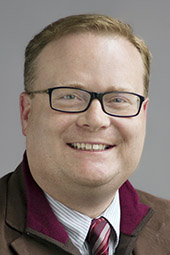
Maurice Pomerantz
In residence for: Year
Office: B202 Extension: 8384 Email: mp147@ias.edu
Home Institution: New York University Abu Dhabi
Research Field: Arabic Literature/Cultural History
Project Title: When the World Spoke Arabic: Maqāmāt and their readers 11th-19th centuries
Research Abstract: My current book project, When the World Spoke Arabic focuses on the history and circulation of the maqāma form. Invented in the fourth/tenth century in Eastern Iran, maqāmāt are collections of fictional narratives of a trickster's travels across cities of the Muslim world and beyond. Like the trickster characters that it often portrays, over its long history the maqāma has displayed a similar capacity to travel and transform. A recent survey of manuscript catalogues from European collections identified nearly two hundred and fifty individual maqāma works and collections in Arabic composed in nearly every major region of the Muslim world from West Africa to East India over the course of nearly a millennium. Drawing on methods of New Comparatist literary scholars such as Franco Moretti who maps the circulation and spread of the novel form onto the rise of the Global World System from the 16th century, my work attempts to situate formal changes to the maqāma within long-term large-scale transformations of economy and society over the longue durée. Central to this work is the attempt to read the imaginative geographies of maqāmāt as central to their production of meaning. My work thus takes seriously what the critic Mark Shell has termed, "the economy of literature," the way that literary works interiorize features of the economic systems through which they circulate." |
 |
Eric Ramírez-Weaver
In residence for: Year
Office: F323 Extension: 8348 Email: ericrw@ias.edu
Home Institution: University of Virginia
Research Field: Medieval Art History
Project Title: Signs of Power: Astrology, Cosmology, and Philosophy in Late Medieval Prague
Research Abstract: Astrological, astronomical, philosophical, cosmological, and military treatises made in Prague ca. 1400 supply superior records of the levels of painterly expression attained during the turbulent reign of Wenceslas IV, king of Bohemia. These codices exemplify aspects of the late medieval Beautiful Style. They also remind us of the otherworldly interests of Wenceslas IV, who has disparagingly been dismissed by historians as a wanton or inefficacious ruler. In fact, these learned illustrated books from Prague at the outset of the fifteenth century document a community of scholars, courtiers, astrologers, and learned professors from Charles University who rallied behind their king and attempted to teach him better information, practices, and strategies benefiting statecraft. Such learned collaborators sustained luxury book production in Prague, projecting an image of courtly stability. At the intersection of art and science, the illustrated manuscripts examined in the proposed project reveal both experimental painterly creativity and preserve aspects of treasured erudition. |
 |
Camille Robcis
In residence for: Second Term
Office: W109 Extension: 8166 Email: crobcis@ias.edu
Home Institution: Cornell University
Research Field: Intellectual History
Project Title: Disoccupation: The Psychiatric Revolution in France, 1945-1975
Research Abstract: This project traces the history of institutional psychotherapy, a psychiatric reform movement born in France after the Second World War. Anchored in Marxism and in Lacanian psychoanalysis, institutional psychotherapy advocated a radical restructuring of the asylum in order to transform the theory and practice of psychiatric care. According to founders of institutional psychotherapy, the war, fascism, and colonialism, had highlighted the fact that occupation was not simply a physical condition: it was also a state of mind. Psychiatry needed to rethink the connection between the social and the psychic if it wanted to truly "disoccupy" the minds of patients. My book begins with an analysis of François Tosquelles, a Catalan refugee doctor who was one of the most important theorizers of institutional psychotherapy at the Hospital of Saint-Alban. The other chapters are organized around individual case studies of doctors, intellectuals, and artists who were deeply influenced by institutional psychotherapy. These include Frantz Fanon who interned at Saint-Alban and who relied on institutional psychotherapy for his psychiatric work in Algeria; Jean Oury who founded the clinic of La Borde in which Félix Guattari was extremely active; the historian of science Georges Canguilhem whose notions of normal and pathological derived from psychiatry; and several Surrealist artists (such as Paul Éluard and Tristan Tzara) who hid in Saint-Alban as they were fleeing fascism. |
 |
Felipe Rojas
In residence for: Year
Office: W222 Extension: 8304 Email: eferoja@ias.edu
Home Institution: Brown University
Research Field: Classical Archaeology
Project Title: Inventing Anatolia
Research Abstract: I am writing a book about how people in the past imagined their own past. Specifically I am studying how the inhabitants Greek and Roman Anatolia manipulated or re-interpreted Bronze and Iron Age landscapes, monuments, and objects. The relevant evidence has never been compiled or analyzed systematically, and yet it has the potential to transform the study of this topic both because the material is copious and complex, and, more importantly, because its examination involves crossing cultural, academic, and political boundaries that were and are fraught with tension. While I focus on the so-called classical periods, I also reflect on how specific Greek and Roman cases are manifestations of long-lasting strategies whereby successive people in the region—from the Hittites to the founders of the Republic of Turkey—have recognized their imagined past in things and manipulated those things to make Anatolian histories. My core questions can be stated succinctly: what kinds of material things incited people in ancient Anatolia to reflect about local or universal antiquity? How were those things reinterpreted or redeployed to substantiate historical narratives? Who was involved in doing so? What was at stake? |
 |
Maria de Lurdes Rosa
In residence for: First Term
Office: F310 Extension: 8328 Email: marialrosa@ias.edu
Home Institution: Universidade Nova, Lisbon
Research Field: Medieval/Early Modern European History
Project Title: Reconstructing noble family archives, remaking family histories (Medieval and Early modern Portugal). Recovered voices, newfound questions.
Research Abstract: The project departs from a previous background of study of noble family archives from Medieval and Early modern Portugal, according to a double perspective - social history of archives, and history of the Ancient Régime family as organization. The archives are primarily an object of study and not a repository of information. On the other hand, the whole context of information production, management and conservation is considered crucial to the full understanding of the problem. In fact, the main goal of the research is to reconstruct the "documentary information" produced by noble/elite families. This perspective draws largely on the renewal of institutional history and on approaches such as Paolo Cammarosano's. The history of the families will be carried out in accordance with this aim. It is already clear that some case-studies will be rich enough to allow broader perspectives on aspects such as wealth management, inheritance conflicts, symbolic practices, literacy, skills on knowledge-based decision, and even political action. The historical materials date from the 14th to the 19th century, and its core are archives inventories, largely unknown, or ignored, until the present research. The project dwells on a sample of 37 inventories, kept in private archives or in public institutions. Their rich contents makes possible to reconstruct a huge amount of documentary production, unknown for the most part, and suggests a new profile to groups depicted in current historiography as dispossessed of management and governance skills. Several historiographical questions on elite and nobility history can therefore be reconsidered. Although the sources relate to the kingdom of Portugal and its overseas possessions, the study will be carried out in a comparative perspective, especially with the Iberian area but also France and Italy. |
 |
Els Rose
In residence for: First Term
Office: F311 Extension: 8326 Email: elsrose@ias.edu
Home Institution: Utrecht University
Research Field: Medieval Latin; Medieval Liturgy
Project Title: The performance of prayer in the early medieval West, 500-800
Research Abstract: My project focuses on the language of faith in the Latin Middle Ages, more specifically the language of prayer in the early medieval West. The main aim of the project is to study the evidence of the liturgical manuscripts for a new understanding of corporate prayer in the Christian community and to develop a new definition of literacy in the early Middle Ages. The main research question is how sacred language functions in this period as an instrument of social inclusion and exclusion in the Christian world. Early medieval culture is generally envisaged as a society with a strong dichotomy between a literate clerical elite and the illiterate lay people. However, the language of prayer in liturgical sources gives cause to question this dichotomy and to reconsider the primary function of prayer in the period. The change of perspective on patterns of social inclusion and exclusion through the prism of the language of worship asks for the development of a new methodology, grounded in the analysis of the manuscripts involved. It approaches prayer as a corporate ritual performance rather than a cognitive statement. In order to develop this methodology, described in more detail in the proposal, I make use of recent models that approach the Latin language in the period after the Roman Empire in the West as a living language, also in its written testimonies where the influence of the spoken language is more visible than was common in the classical period. In addition, I will develop new tools to analyze patterns of textual correction in the manuscripts, in order to distinguish more clearly between linguistic features that were accepted as common usage in living Latin, and others that were considered as deviant. Finally, I propose a performative approach to liturgy to situate textual sources in their ritual context, with special attention for patterns of participation. The consideration of prayer as a corporate performance in the interplay of word and ritual and in comparison with other sacred languages, provides a contextualization of religious language that will change our perspective on patterns of socio-religious inclusion and exclusion in the early medieval West. |
 |
Rebekah Rutkoff
In residence for: Year
Office: A111 Extension: 4567 Email: rrutkoff@ias.edu
Home Institution: Institute for Advanced Study
Research Field: Cinema Studies
Project Title: Cinematic Incubation
Research Abstract: Cinematic Incubation is the first monographic study of American avant-garde filmmaker Gregory J. Markopoulos's expanded cinema event called the Temenos. A key figure in the New American Cinema of the 1960s, Markopoulos (1928-1992) became increasingly disgusted with the conditions and economies of screening and distribution in the US and left for Europe in 1967, withdrawing his films from circulation and refusing screenings, and remained there until his death. For Markopoulos, the delicate and, in his words, "divine" potential of film was too easily damaged when the artist ceded screening responsibility to curators and institutions with their own priorities, both financial and psychological. He wished to bring spectators into unsullied, elemental contact with the medium in a context supportive of its singular powers, and therefore envisioned a situation unique to the presentation of his films: the Temenos, a Bayreuth-like destination in Arcadia for the viewing and study of his films and accompanying writings, a world unto itself. Temenos, ancient Greek for "a place set apart" or "sacred space," was Markopoulos's name for both the site and screening event. Ultimately, he created the silent, eighty-hour Eniaios for exclusive viewing in this location; religion scholar Jeffrey Stout has called it "the most ambitious work of religious art of the twentieth century." Cinematic Incubation investigates the evolution of the Temenos, tracing the unfolding of the filmmaker's deeply original film language and his radical exploitation of the single frame. It looks at the origins of the filmmaker's vision of cinema as a therapeutic form in ancient Greek rituals and theories of cure, particularly those involving the god of healing Asclepius. And it also investigates the pragmatic function of the Temenos, considering its impact on hundreds of pilgrim-spectators who travel to Arcadia to encounter Markopoulos's extreme vision. |
 |
Emmanuelle Saada
In residence for: First Term
Office: W216 Extension: 8356 Email: esaada@ias.edu
Home Institution: Columbia University
Research Field: Law and Colonialism
Project Title: The Invention of the Native: Rule of Law and Violence in the Making of Colonial Algeria (1830-1902)
Research Abstract: First conquered in 1830, Algeria was the centerpiece of the French empire and a laboratory for techniques of colonial rule. Among these techniques was the invention of the category of the "native" (indigène)—the central social and legal distinction of the empire. My project is a history of the invention of the "native" in Algeria. Far from a given or an epistemic condition of the conquest, the couplet "European" and "Native" was the product of a fifty-year process of categorization in which law played the central role. For colonial actors, law was a language to describe and make sense of the social world. It provided a set of categories used to distribute power and land; it granted access to or excluded individuals from different social settings; and it regulated everyday interactions between colonizers and colonized. My project analyses court cases, legal debates, and colonial jurisprudence in order to understand the formation of the legal category of the native at the intersection of private law, criminal law and land law. It draws together colonial archives from the governor's office and from two towns in the vicinity of Algiers, Bouzareah and Blida, to explore how routine administrative work was saturated by legal categories and modes of reasoning that affected the everyday lives of natives. And it examines the modes of contestation adopted by the ‘natives' by analyzing their petitions to the colonial administration. By looking at the articulations between law and violence, this project attempts to close the gap between two divergent accounts of the colonial state—one that insists on its recourse to extreme violence and another that envisions the colonies as the laboratory of modern "governmentality." Second, by insisting on the local and progressive nature of the construction of colonial categories, this project revisits the debate about the historical relation between orientalist representations and actual technologies of rule by suggesting that, far from enabling domination, the categorical couple of "European" and "native" was a product of it. |
 |
Carlo Scardino
In residence for: Year
Office: A101 Extension: 4618 Email: cscardino@ias.edu
Home Institution: Heinrich-Heine-Universität Düsseldorf
Research Field: Graeco-Arabica
Project Title: Anatolius Arabicus: a lost Greek author in Arabic
Research Abstract: The goal of the research outlined below is the completion of a critical edition with translation and explicative commentary of the Arabic translation of Anatolius Berytius's Greek agricultural compilation (4th-5th cent. AD). Although now lost in the original Greek, Anatolius' text was highly esteemed in Constantinople—Photius mentions it in his Bibliotheca as representative of the entire genre of agricultural literature. With the help of the Arabic versions, which when compared with their Syriac and Armenian equivalents most accurately reflect Anatolius' original work, the latter can be situated within its contemporary context and properly described in terms of its literary composition and intended effect. Since Anatolius was also an important source for the Geoponica—the 10th-century AD Byzantine compilation—systematic comparison of the two works can help to shed light upon our understanding of the latter's genesis, which due to the loss of all its original Greek sources has yet to be convincingly explained. It will also help us better understand the selection criteria of the Geoponica's Byzantine compiler. In addition, an edited text of Anatolius opens up the possibility for insights into a hitherto neglected field: scientific literature of Late Antiquity. A comparative study of the importance of agriculture in the process of cultural transfers between Greco-Roman Late Antiquity and early-Middle Age Arabic culture, as well as of the particular types of reception of Greek literature by Arabs (ranging from translations to free adaptations), including comparisons with other examples of scientific knowledge inherited from the ancient tradition, round off the project. |
 |
Daniel Smail
In residence for: Second Term
Office: F310 Extension: 8328 Email: smail@ias.edu
Home Institution: Harvard University
Research Field: History and Anthropology of Medieval Southern Europe
Project Title: The Material Ecology of Late Medieval Europe
Research Abstract: In recent years, scholarship in the humanities has experienced a striking turn to the material. The desire to study tangible things follows naturally upon an era of scholarship that for several decades has been oriented around the study of words and categories of thought. For the most part, this literature has treated material culture as the passive partner in the human-thing relationship. Thanks to new developments in evolutionary theory, animal studies, and climate studies, however, it is now possible to see how all historical relationships are coevolutionary in nature, and in particular to grasp the fact that human societies both change and are changed by the environments in which they are embedded. With this insight in hand, it is possible to return to periods such as later medieval Europe and to approach the dramatic material transformations of the era from an ecological perspective. Over the high Middle Ages, Europe began to grow wealthy, and as wealth gradually sedimented out of circulation, it took form as household goods, fashionable clothes, and domestic architecture. The changing material ecology of things had a powerful impact on European society, altering the way in which people related to things and transforming the system of signs used to fashion identity and to display friendship and belonging. The transformations are attested or mediated by trends in many different fields or domains, such as art, architecture, literature, food history, and the historical and archaeological record. Using a range of sources and methodologies, and drawing heavily from a collection of "textual things" that I have been gathering for a project in the Digital Humanities, "The Documentary Archaeology of Late Medieval Europe," my goals for this fellowship period at the IAS are to pull out several major themes and explore them using an ecological approach as a guiding theoretical context. These themes include the nature of prestige investments, the materiality of devotional practices, the forms of collecting or hoarding, and the cognitive dimensions of mathematical literacy in everyday life. |
 |
Paul Smith
In residence for: First Term
Office: W102 Extension: 8354 Email: pjakovsmith@ias.edu
Home Institution: Haverford College
Research Field: Chinese History
Project Title: Faces of war in mid-Song China: Remilitarizing the literati state, 1040-1142
Research Abstract: By accepting the Chanyuan treaty with the Kitan Liao in 1005 the rulers of the Northern Song dynasty (960-1127) consolidated their regime by replacing warfare with peace payments as the primary tool for securing the borders, courting literati through a robust policy of "advancing civil teachings and suppressing military affairs," and transforming the once-powerful officer corps into a demeaned appendage of the literati state. But the Chanyuan model was challenged in 1040 when a Tangut invasion of Shaanxi humiliated Song defenders. The frustrations incited by the 1040s war initiated a century-long cycle of remilitarization that only ended when the truncated Southern Song (1127-1279) negotiated another Chanyuan-style peace accord with its would-be conqueror, the Jurchen Jin, in 1142. Faces of War focuses on the power of war to transform political agendas and launch unexpected men to power. By highlighting representative clusters of individuals who personify the politics of war, I show how in this evolution from a war of necessity (the 1040s) through wars of choice (1068 to ca. 1125) to a war of desperation (1127 to 1142), decisions about national strategy and ultimately the fate of the realm increasingly departed from the ideal of literati control proclaimed by the Song founders and enshrined in the Chanyuan agreement. |
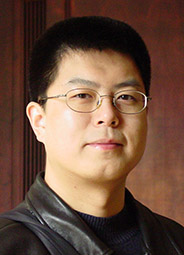 |
Mingwei Song
In residence for: Second Term
Office: W106 Extension: 8355 Email: mingwei@ias.edu
Home Institution: Wellesley College
Research Field: Modern Chinese Literature
Project Title: Posthuman China: Virtual Subjectivities, Utopian/Dystopian Nations, and Science Fiction
Research Abstract: This book project explores the political, ethical, and epistemological connotations of posthumanity, a central literary motif in twenty-first-century Chinese fiction, particularly science fiction. The representations of posthuman bodies, subjectivities, nations, and cosmos challenge a certain utopianism based on evolutionary thinking and a cultural confidence in national rejuvenation that have prevailed in modern China for over a century. Posthumanism is a subversive vision in the context of China's pursuit of power and wealth, a nightmarish counterpart to the "Chinese dream." In particular, the cutting-edge literary experiments that characterize the new wave of Chinese science fiction transgress the conventions of gender, class, people, and nation, evoking sensations ranging from the uncanny to the sublime, from the corporeal to the virtual, and from the apocalyptic to the transcendent. Through analyzing several major novels from Taiwan, Hong Kong, and the PRC in light of posthuman aesthetics, this book questions the conditions of humanity in a new age blessed, or menaced, by posthuman possibilities. Combining literary studies with historical studies of culture and society, this project is interdisciplinary by nature. The main disciplinary area is modern Chinese literature, but my research is also grounded in comparative literature and cultural history. Through exploring fictional representations of posthuman images in the context of China's changing political culture over the past three decades, this project emphasizes the convergence of literature, history, politics, and science. In a more general sense, the study of the posthuman discourse and literary images, which are sometimes considered to mark the very end of the humanist tradition, asks questions about the present and future of humanism and points to potential paradigm shifts in the humanities. This project aims to enable reflections on culture, ideology, gender, class, science, and technology as well as the enlightenment ideas and revolutionary practice that have characterized modern culture in China and elsewhere. |
 |
Deborah Steiner
In residence for: First Term
Office: W224 Extension: 8363 Email: dsteiner@ias.edu
Home Institution: Columbia University
Research Field: Classics/Ancient Greek Literature
Project Title: Choral Constructions: Chorality in the archaic and early classical Greek material, visual and textual record
Research Abstract: This project explores the idea of the chorus in archaic and early classical Greek culture from two chief perspectives. The first of these involves delineating the mythical and real world archetypes on which choruses are shown to fashion themselves in art and text—among them stars, dolphins, halcyons, cranes, herds of horses, Nereids and Deliades, and assemblages of columns and cauldrons; among the more unlikely models are Gorgons, depicted by early artists as a chorus line and described by poets as prototypical performers of lament whose morphology conforms to that of the conventional maiden chorus, with Medusa as choregos. Close readings of poetic texts (chiefly lyric), visual images and artefacts from the eighth through to the fifth century explicate these heterogeneous pairings and investigate the myths and motifs brought into play. The study's second facet identifies a set of cultural institutions and practices, chiefly temple architecture, votive dedications, writing, weaving, and the Greek ‘epigraphic habit', which inform and are in turn informed by concepts of chorality. Pindar's equation of his choristers with gleaming columns reflects the real-world design and placement of pillars at sacred sites, where they stand in the linear and rectangular alignments that choruses adopt; caryatids supporting temple and treasury lintels in Delphi and Athens have their origins both in the columns found at Ionic temples in Asia Minor decorated with choruses performing ring dances, and in the actual chorus serving at the shrine of Artemis Karyatis in Sparta. Inscriptions on vases from the eighth-century Dipylon oinochoe on describing performances of song and dance deploy alphabetic letters as stand-ins for and revisualizations of choristers, just as later theoretical descriptions of writing use choral vocabulary to explain how single letters combine in sequences of sounds and words; as epigraphic texts show, these alphabetic assemblages may adopt choral formations and perform their own letter dances. As the project thus demonstrates, chorality proves a concept ‘good to think with' that supplies a paradigm readily mapped onto diverse realms. |
 |
Noël Sugimura
In residence for: Year
Office: W215 Extension: 8357 Email: nsugimura@ias.edu
Home Institution: Georgetown University
Research Field: History of Enlightenment Cultures
Project Title: "Perplexity of Contending Passions": Milton and His Readers
Research Abstract: "Perplexity of Contending Passions": Milton and His Readers (under contract at Oxford University Press) is the first book to study how literary history and the history of scholarship on Milton and his poetry in eighteenth-century England provides a hitherto neglected and critical lens through which we might better understand why English Enlightenment culture developed in the particular way it did. It explores how early eighteenth-century English enlightenment readers—chiefly "clerical Miltonists"—struggled to contain not only Milton's political legacy, but also the radical thinking emerging from his poetry. It contends that these early readers of Milton's poetic oeuvre employed the paratextual apparatus of editions, the genre of the commentary, and printed remarks to contain the radicalism inherent in Milton's verse, thereby presenting Milton as a figure of toleration and religious orthodoxy firmly situated on the side of the Church of England. Yet their observations—both printed and in manuscript—draw unwitting attention to the dangerous philosophic and political radicalism to which Milton's poetry tends; their anxieties over whether they were successfully domesticating Milton's poetry end up inadvertently highlighting the very places where Milton's thinking is at its most heterodox. Later Romantic readers of the "High Enlightenment", who were schooled in these same editions and commentaries, sought to recover this latent radicalism and expand on it. What my study reveals, therefore, is how early literary and aesthetic debates in England—largely influenced by the Quarelle as well as by discussions on Longinus—effectively pulled enlightenment interpretations of Milton and his sublimity into two fundamentally different and diametrically opposed directions: toward a clerical conservatism, on the one hand, and a later Romantic radicalism, destructive to such conservatism and its traditional hierarchies, on the other. |
 |
Kenneth Swope
In residence for: First Term
Office: W106 Extension: 8355 Email: kmswope@ias.edu
Home Institution: University of Southern Mississippi
Research Field: Chinese Military & Social History
Project Title: : On the Trail of the Yellow Tiger: War, Trauma & Social Dislocation in Southwest China during the Ming-Qing Transition
Research Abstract: This book project focuses on the traumatic Ming-Qing dynastic transition in seventeenth-century China by examining one of its most infamous figures, the peasant rebel Zhang Xianzhong, better known as the "Yellow Tiger" or the "Butcher of Sichuan." Zhang had occupied the city of Chengdu, Sichuan, in the eighth month of 1644, some three months after the fall of Beijing to the Qing, and declared it his Western Capital (Xi Jing). Over the next three years, Zhang's atrocities would multiply as his enemies closed in and his paranoia increased. According to surviving accounts, he would massacre hundreds of thousands, including Buddhist monks and scholars who showed up for bogus exams to serve his regime. In some cases, even dogs and chickens were not spared. His generals were rewarded based upon the number of severed hands they turned in. By the time he was killed by Qing forces in 1647, some estimates suggest only 1% of the populace survived. It was said that only tigers flourished due to the widespread availability of decaying human flesh. Famine and cannibalism were reportedly rampant and one could allegedly travel hundreds of miles without seeing a living soul. Even worse for the hapless residents of China's southwest, they would be plagued by warfare for nearly two decades after Zhang's death as rival warlords, Ming loyalists, Qing conquerors and former peasant rebel leaders contested for power. Horrific as these events were, they generated a vast spate of memoirs, unofficial histories, battle dispatches and other primary sources that offer us a fascinating glimpse into how people experienced and remembered warfare in the seventeenth century. Drawing upon insights from scholars in other fields such as trauma and memory studies and cultural anthropology, I examine contemporary and later accounts of Zhang's bloody reign of terror and its aftermath and analyze the social and environmental implications of this era of conflict. |
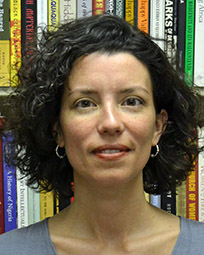 |
Meredith Terretta
In residence for: Year
Office: W111 Extension: 8060 Email: terretta@ias.edu
Home Institution: University of Ottawa
Research Field: African History, Law & Transnational Activism
Project Title: Along the Global Fringe: Rogue Lawyers as Rights Activists in Africa from the 1920s to the Early Independence Years
Research Abstract: By following activist lawyers and their defendants in Africa from the 1920s to the 1970s, this book will examine the League of Nations and its successor, the United Nations, as networking hubs for Africans' politically and legally constructed rights claims that crossed imperial boundaries. The League of Nations' formation enabled activist lawyers of Caribbean, Asian, Oceanic or African origin to employ legal and rhetorical strategies to challenge the international order in formation by advocating for Africans under European rule. After World War II, leftist metropolitan lawyers joined in the defense of African anticolonialists. In the United Nations trust territories, African activists and their advocates formulated legal arguments against foreign rule in colonial courtrooms. Cause lawyering in late imperial Africa developed a legal strategy of rupture, legitimized the anticolonialist use of violence and brought colonial powers' use of emergency legislation under public scrutiny. After independence, legal activists mobilized against emergency legislation and its normalization in postcolonial regimes. This book will be one of the first to trace the historical contingencies undergirding the deformations of the rule of law that engendered legalized single-party rule, preventive detention, execution and torture in many post-independence African countries. The book will also examine the shifts in trans-regional activism in and beyond Africa from c. 1920 to c. 1970. It will consider the tensions that surfaced between African lawyers and those of other parts of empire during the interwar period, between white metropolitan lawyers and those of colonial origin in the postwar period, and between European leftists and African nationalists in activist networks. It will show how human rights NGOs and lawyers' collectives relied on African activists' understanding of (post)colonial governance in their collaborative construction of legal activism. Finally, it will shed light on transformations in North-South collaborative activism as "colonial Africa" emerged as "Third World Africa" on the global stage. |
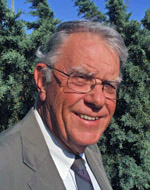 |
Stephen Tracy
In residence for: Year
Email: stracy@ias.edu
Home Institution: American School of Classical Studies at Athens
Research Field: Greek History and Epigraphy
Project Title: Greek epigraphy, Hellenistic history, Greek and Latin epic poetry.
Research Abstract: Stephen Tracy is helping English and Australian colleagues prepare a new edition of Athenian decrees of the late fourth to third centuries B.C. He is also working on Athenian letter cutting of the second half of the fifth century B.C. and on the hands of the so-called “Athenian Tribute Lists.” |
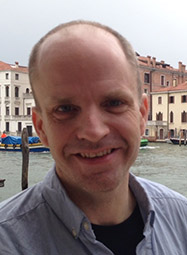 |
John Tresch
In residence for: First Term
Office: W109 Extension: 8166 Email: jtresch@ias.edu
Home Institution: University of Pennsylvania
Research Field: History of Science and Technology
Project Title: Poe's Engineering: Twisted Fictions, Incredible Facts, and the Forging of American Science
Research Abstract: In Edgar Allan Poe's famous works, unreliable narrators detailed gory scenes of murder, madness, and despair. Yet Poe also wrote in depth about the conditions of scientific certainty. His early passion for natural history, as in the "The Gold Bug," was complemented by the training in mathematics and military engineering he received as a cadet at West Point. Even his most morbid antiheroes and lurid scenes employed the elevated language of rationality. Poe's Engineering is the first book to focus on the impact of new sciences and technologies on Poe's life and work. It also unearths a crucial, neglected period in the history of American science. In the 1830s and 40s, amateurs and enthusiasts devoured unsettling theories of species change, convertible fluids, and the birth of stars. A flood of new publications appeared, yet new journals often placed scientific reports alongside fashion plates, poems, and tales of fiction, leaving the author, source, or intended tone of articles obscure. Uncertainty over who had the right to speak for nature was heightened by theological conflicts and controversies over mesmerism, materialism, and the mutability of species. While a handful of elite scientists sought to forge centralized national institutions to secure scientific authority, Poe's work described and exploited this epistemic instability and made it a central feature of his tales, criticism, and natural philosophy. Though he often mocked the ambitions of the nation-builders and prophets of mechanical progress, elsewhere he endorsed the emerging national framework. Poe's "second natures" reflected contemporary visions of imperial conquest and settlement. Yet Poe challenged the growing public role of mechanism and calculating rationality, and was one of the first to sound the alarm about industry's depredations of the "art-scarred" earth. Poe's Engineering reveals an important dimension of this exceptional author. It also casts light on a decisive period in American science—one which anticipates the present in its alternating admiration and horror at the power of science and industry to reveal, remake, and unravel the world. |
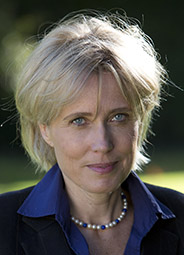 |
Karina Urbach
In residence for: Year
Email: urbachk@ias.edu
Home Institution: University of London
Research Field: Modern International Relations & Jewish Family History
Research Abstract: Karina Urbach has worked on the role of elites in the International Relations of Europe in the first half of the 20th century. Her new project will focus on the impact former Nazis had on German society after 1945. |
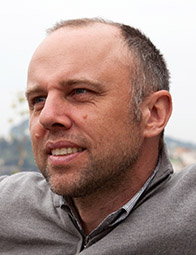 |
WIlliam Van Andringa
In residence for: Second Term
Office: W218 Extension: 8358 Email: vanandringa@ias.edu
Home Institution: Université Lille Nord de France – Lille 3
Research Field: Roman Archaeology and Religion in Late Antiquity
Project Title: Pagan Gods Changing in the Roman West (IIIrd-IVth cent. AD) Archaeology and Religious Changes in Late Antiquity
Research Abstract: The aim of this project is to study and to re-evaluate the fundamental problem of religious transformations in Late Antiquity. The starting point is based on a series of recent excavations in the western provinces of the Empire, particularly in Gaul, showing that a certain number of great civic sanctuaries, built at great expense by the local 'elites in the first and second centuries, were dismantled or abandoned in the second half of the third century. This phase of abandonment reveals an essential change in religious practices of the provinces, occurring even before the conversion of Constantine and the rise of Christianity to official religion. The abandonment of the sanctuaries gives rise to general and debated questions about the continuity of the city-state and the organization of the Empire in Late Antiquity. This research project, with an archaeological analysis at the core of its approach, aims to study the cult places and religious practices in the third and fourth centuries. Priority will be given to recent archaeological investigations, which enable us to evaluate the transformation of cult places and rituals in necessary detail. In particular, the project will show that the changes in the administration of the Empire are at the base of a second Pagan era, which could be termed an ‘occasional Paganism’: pragmatic, functioning in closed social circles, as opposed to the ancient form of Paganism, which was based on the city-state and celebrated by large public sacrifices organized and financed by magistrates and priests. The anti-pagan laws under Theodosius did not mark the end of Paganism but the end of a kind of Paganism, which had been born in the crisis of the third century. It is in order to carry out such a research program that I submit an application for a membership at the Institute for Advanced Study (School of Historical Studies). This project will result in a monograph. |
 |
Marga Vicedo
In residence for: Year
Office: W108 Extension: 8165 Email: margavicedo@ias.edu
Home Institution: University of Toronto
Research Field: History of Science
Project Title: A Mother's Siege: Autism, Emotions, and Gender
Research Abstract: My project is the first book-length study of the history of autism research in the United States. When psychiatrist Leo Kanner identified autism in 1943 it was practically unknown. Now, many consider it an epidemic. Major research pro- grams investigate this condition as social concern continues to grow. Dealing with autism has led to policy changes in education and early intervention programs in child development. It has also shaped our views on disability, neurodiversity, and emotional selfhood. My book project explores the history of autism by weaving the analysis of scientific debates with the personal history of Clara Park (1923-2010), the mother of an autistic daughter. Park was the first mother to challenge in print the view that maternal rejection caused autism. After raising three healthy children, she recounted the unusual development of Jessica, her autistic daughter, and her struggle to find medical help in her 1967 book The Siege. The Siege provided much needed encouragement for mothers with autistic children. A classic in the field, it is still in print. Park wrote other influential books and articles on autism. She also played a crucial role in galvanizing research into the organic origins of autism, and in mobilizing parental advocacy. Through her story, I explore how views on autism shaped and were shaped by larger debates about the nature of emotions, science, and human nature. My study illuminates the impact of autism on families and the influence of parents on scientific and social views of autism. It also shows how autism became a platform for debating fundamental issues such as the nature of emotions, science, and biological determinism. |
 |
James Webb, Jr.
In residence for: First Term
Office: W217 Extension: 8362 Email: jlawebbjr@ias.edu
Home Institution: Colby College
Research Field: Historical Epidemiology
Project Title: The Guts of the Matter: A Global Environmental History of Enteric Diseases, Biomedicine, and Public Health
Research Abstract: The Guts of the Matter: A Global Environmental History of Enteric Diseases, Biomedicine, and Public Health An array of viruses, bacteria, and parasites cause intestinal diseases. Together, they constitute one of the largest global disease burdens, and diarrheal diseases alone are one of the principal causes of childhood death. My project is a broad, first-generation exploration of the global environmental history of enteric diseases and the changing cultural, biomedical, and public health practices that have influenced the transmission of pathogens. It is based, in part, on the scientific literature on the viruses, bacteria, and parasites that cause enteric diseases, studies of the efficacy of biomedical interventions, and the new understandings of the impacts of polluted environments on the human microbiome. It is rooted in an historical investigation of cultural attitudes toward human waste; changing patterns in the use of night soil for agriculture; waste disposal practices in rural and urban areas; the epidemiological consequences of the vast sewage farms that were maintained for the waste of urban populations before the construction of sewerage systems; the evolution of wastewater treatment technologies; the impacts of biomedical interventions including chemical therapy to clear helminthic and protozoal parasites, immunizations to prevent rotovirus, and oral rehydration therapy; the impacts of food and water safety legislation; the global initiative to promote hand-washing with soap; and governmental and non-governmental organizations' initiatives to reduce open defecation. Surprisingly, despite the magnitude of the disease burden caused by enteric pathogens, this topic has not been investigated in a global or environmental framework that takes into account the changing epidemiology of pathogenic transmission and the history of biomedical and public health interventions. I plan to use the fellowship at the Institute for Advanced Study to write a book on the global environmental history of enteric diseases, biomedicine, and public health. |