Former Faculty: JOHN NORRIS BAHCALL
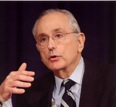
Faculty, Astrophysics, School of Natural Sciences, July 1971–August 2005 (Richard Black Professor, 1997–2005); Member, Astrophysics, School of Natural Sciences, January 1969–June 1970
- * PhD: Harvard University, 1961
- * Born: December 30, 1934 in Shreveport, LA; Deceased: August 17, 2005
Career Highlights:1
- * Dr. Bahcall's most recognized scientific contribution was the novel proposal in 1964, together with Raymond Davis Jr., that scientific mysteries of our sun – how it shines, how old it is, how hot it is – could be examined by measuring the number of neutrinos arriving on Earth from the sun. Neutrinos are weakly interacting elementary particles that travel at nearly the speed of light. They are produced as byproducts of the nuclear fusion reactions that power stars. Measuring the properties of these neutrinos tests both our understanding of how starts shine and our understanding of fundamental particle physics.
- * Dr. Bahcall contributed to many other areas of astrophysics in addition to neutrino astrophysics, including the study of dark matter in the universe, quasar properties, galactic structure, the evolution of stars, and the identification of the first neutron star companion.
- * Dr. Bahcall created the astronomy group at the Institute for Advanced Study, which became a leading training ground in the country for post-graduate researchers. He also helped establish astronomy groups at the Weizmann Institute and Tel Aviv University of Israel, among others.
- * Dr. Bahcall led the effort to create the Hubble Space Telescope in the 1970's together with Lyman Spitzer; chaired the National Academy of Science committee that created the decade roadmap for U.S. astronomy research, which came to be known as the Bahcall Report; and served as President of the American Astronomical Society from 1990–1992.
Awards/Prizes include:
- * NASA Distinguished Public Service Medal (1992)
- * U.S. National Medal of Science (1998)
- * Hans Bethe Prize of the American Physical Society (1998)
- * Dan David Prize of Israel (2003)
- * Gold Medal of the Royal Astronomical Society (2003)
- * Fermi Award (2003, with Raymond Davis)
- * Benjamin Franklin Medal in Physics (2003, with Raymond Davis and Masatoshi Koshiba)
Additional information on his life and work can be found at http://www.ias.edu/sns/~jnb/
1excerpts from his Institute for Advanced Study on-line obituary