DeepMind Workshop Morning Brainstorm Blackboard Sticky Notes

School of Mathematics

Upcoming Seminars
Wednesday, Apr 01, 2026 | 6:00pm
Maya Sankar, Institute for Advanced Study
Chromatic Numbers, Graphs Build on Groups, and Discrete Homotopy
Abstract

A few years ago, I was introduced to a surprising result of Payan stating that certain highly symmetric "cube-like" graphs cannot have chromatic number exactly $3$. (Specifically, his result applies to graphs on vertex set $(\mathbf{Z}/2\mathbf{Z})^d$ for some d that are translation-invariant: every translation $\vec{v} \mapsto \vec{v}+\vec{x}$ of the vertex set is also an automorphism of the graph.)  Payan's theorem is unexpected because one generally shows a graph $H$ either has chromatic number $\leq k$ or $>k$ --- which is equivalent to $H$ being $k$-colorable or not. In comparison, this theorem states a cube-like graph is either $2$-colorable or non-$3$-colorable, which are difficult conditions to compare.

In this talk, I'll tell you a short new proof of Payan's theorem (joint with Mike Krebs). The proof uses topological ideas and applies beyond cube-like graphs --- including to quadrangulations of $\mathbf{RP}^2$ and to translation-invariant graphs on $(\mathbf{Z}/4\mathbf{Z})^d$.

Add to calendar Wednesday, 2026-04-01 18:00Wednesday, 2026-04-01 20:00America/New_YorkMathematical Conversationsuse-titleTopic: Chromatic Numbers, Graphs Build on Groups, and Discrete Homotopy Speakers: Maya Sankar, Institute for Advanced Study More: https://www.ias.edu/math/events/mathematical-conversations-315 A few years ago, I was introduced to a surprising result of Payan stating that certain highly symmetric "cube-like" graphs cannot have chromatic number exactly $3$. (Specifically, his result applies to graphs on vertex set $(\mathbf{Z}/2\mathbf{Z})^d$ for some d that are translation-invariant: every translation $\vec{v} \mapsto \vec{v}+\vec{x}$ of the vertex set is also an automorphism of the graph.)  Payan's theorem is unexpected because one generally shows a graph $H$ either has chromatic number $\leq k$ or $>k$ --- which is equivalent to $H$ being $k$-colorable or not. In comparison, this theorem states a cube-like graph is either $2$-colorable or non-$3$-colorable, which are difficult conditions to compare. In this talk, I'll tell you a short new proof of Payan's theorem (joint with Mike Krebs). The proof uses topological ideas and applies beyond cube-like graphs --- including to quadrangulations of $\mathbf{RP}^2$ and to translation-invariant graphs on $(\mathbf{Z}/4\mathbf{Z})^d$. Simons Hall Dilworth Room a7a99c3d46944b65a08073518d638c23
Thursday, Apr 02, 2026 | 3:30pm
Robert Lemke Oliver, University of Wisconsin
The Least Prime with a Given Cycle Type
Abstract

The Chebotarev density theorem is a powerful tool in number theory, in part because it guarantees the existence of primes whose Frobenius lies in a given conjugacy class in a fixed Galois extension of number fields.  However, for some applications, it is necessary to know not just that such primes exist, but to additionally know something about their size, say in terms of the degree and discriminant of the extension.  In this talk, I'll discuss recent work with Peter Cho and Asif Zaman on a closely related problem, namely determining the least prime with a given cycle type.  We develop a new, comparatively elementary approach for thinking about this problem that nevertheless frequently yields the strongest known results.  We obtain particularly strong results in the case that the Galois group is the symmetric group S_n for some n, where determining the cycle type of a prime is equivalent to Chebotarev.

Add to calendar Thursday, 2026-04-02 15:30Thursday, 2026-04-02 16:30America/New_YorkJoint PU/IAS Number Theoryuse-titleTopic: The Least Prime with a Given Cycle Type Speakers: Robert Lemke Oliver, University of Wisconsin More: https://www.ias.edu/math/events/joint-puias-number-theory-59 The Chebotarev density theorem is a powerful tool in number theory, in part because it guarantees the existence of primes whose Frobenius lies in a given conjugacy class in a fixed Galois extension of number fields.  However, for some applications, it is necessary to know not just that such primes exist, but to additionally know something about their size, say in terms of the degree and discriminant of the extension.  In this talk, I'll discuss recent work with Peter Cho and Asif Zaman on a closely related problem, namely determining the least prime with a given cycle type.  We develop a new, comparatively elementary approach for thinking about this problem that nevertheless frequently yields the strongest known results.  We obtain particularly strong results in the case that the Galois group is the symmetric group S_n for some n, where determining the cycle type of a prime is equivalent to Chebotarev. *Princeton University, Fine 214*a7a99c3d46944b65a08073518d638c23
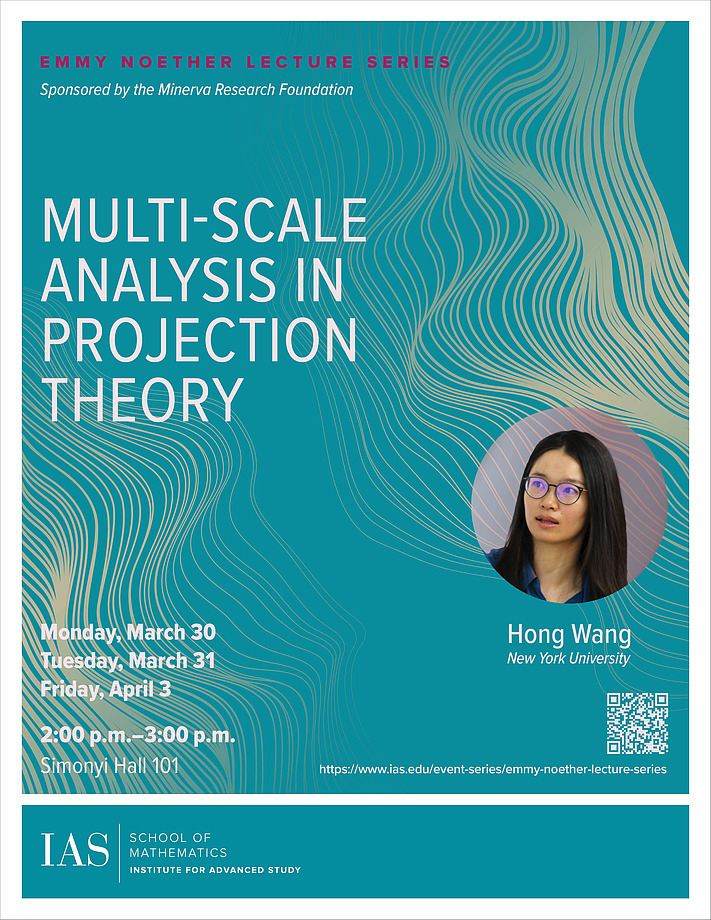
Friday, Apr 03, 2026 | 2:00pm
Hong Wang, NYU
Multi-scale Analysis in Projection Theory
Abstract
ENLS 2026

Sponsored by the Minerva Research Foundation

Abstract: Projection theory asks how the size of a set in $R^n$—often measured by Hausdorff dimension—behaves under projections onto lower-dimensional spaces, both for orthogonal projections and for more general nonlinear families. One would like to understand when dimension is typically preserved and to control the (often small) exceptional set of directions or parameters where it is not.


In this lecture series we study how to find structures in an arbitrary set in $R^n$ and how those structures can be used to prove projection estimates.  We will survey discretized and multi-scale ideas initiated by Bourgain and developed further by Shmerkin, Orponen, and others, which yield recent progress on projection problems. 

Add to calendar Friday, 2026-04-03 14:00Friday, 2026-04-03 15:00America/New_YorkEmmy Noether Lecture Seriesuse-titleTopic: Multi-scale Analysis in Projection Theory Speakers: Hong Wang, NYU More: https://www.ias.edu/math/events/emmy-noether-lecture-series-1   _Sponsored by the Minerva Research Foundation_ Abstract: Projection theory asks how the size of a set in $R^n$—often measured by Hausdorff dimension—behaves under projections onto lower-dimensional spaces, both for orthogonal projections and for more general nonlinear families. One would like to understand when dimension is typically preserved and to control the (often small) exceptional set of directions or parameters where it is not.   In this lecture series we study how to find structures in an arbitrary set in $R^n$ and how those structures can be used to prove projection estimates.  We will survey discretized and multi-scale ideas initiated by Bourgain and developed further by Shmerkin, Orponen, and others, which yield recent progress on projection problems.  Simonyi Hall 101a7a99c3d46944b65a08073518d638c23
Friday, Apr 03, 2026 | 2:00pm
Naomi Sweeting, Princeton University
Iwahori Hecke Algebra and Their Representations
Abstract
Add to calendar Friday, 2026-04-03 14:00Friday, 2026-04-03 16:00America/New_YorkLearning Seminar on Geometric Representation Theoryuse-titleTopic: Iwahori Hecke Algebra and Their Representations Speakers: Naomi Sweeting, Princeton University More: https://www.ias.edu/math/events/learning-seminar-geometric-representation-theory-7 Bloomberg Lecture Hall (BH-101)a7a99c3d46944b65a08073518d638c23
Monday, Apr 06, 2026 | 11:00am
Jiatu Li , Massachusetts Institute of Techology
Computer Science/Discrete Mathematics Seminar I
Abstract
Add to calendar Monday, 2026-04-06 11:00Monday, 2026-04-06 12:00America/New_YorkComputer Science/Discrete Mathematics Seminar Iuse-titleSpeakers: Jiatu Li , Massachusetts Institute of Techology More: https://www.ias.edu/math/events/computer-sciencediscrete-mathematics-seminar-i-620 Simonyi Hall 101 and Remote Accessa7a99c3d46944b65a08073518d638c23
Monday, Apr 06, 2026 | 1:30pm
Hugh Woodin, Harvard University
The AD+ Duality Program
Abstract

The study of descriptive set theory in the context of determinacy axioms began nearly 60 years ago. The context for this study is now understood to be the Axiom AD+, which is a refinement of the Axiom of Determinacy (AD).  The objects of this study are the universally Baire sets of reals which form a transfinite  hierarchy which extends the borel sets.

This has led to what is arguably the main duality program of Set Theory, which is the connection between the universally Baire sets,  and generalizations of L, the inner model of the universe of sets constructed by Gödel.

Add to calendar Monday, 2026-04-06 13:30Monday, 2026-04-06 14:30America/New_YorkMembers' Colloquiumuse-titleTopic: The AD+ Duality Program Speakers: Hugh Woodin, Harvard University More: https://www.ias.edu/math/events/members-colloquium-102 The study of descriptive set theory in the context of determinacy axioms began nearly 60 years ago. The context for this study is now understood to be the Axiom AD+, which is a refinement of the Axiom of Determinacy (AD).  The objects of this study are the universally Baire sets of reals which form a transfinite  hierarchy which extends the borel sets. This has led to what is arguably the main duality program of Set Theory, which is the connection between the universally Baire sets,  and generalizations of L, the inner model of the universe of sets constructed by Gödel. Simonyi 101 and Remote Accessa7a99c3d46944b65a08073518d638c23
Monday, Apr 06, 2026 | 3:15pm
Katepalli R. Sreenivasan, New York University
Everything You Always Wanted to Know About Decaying Turbulence: But Were Afraid to Ask
Abstract

Abstract:Gently stir a fluid in a large box sitting still. This talk is about the behavior of turbulence that is generated. We report results of large numerical simulations of the Navier-Stokes equations in a triply periodic box---and compare the outcomes with classical work, which was begun in the 1940s, and with Alexander Migdal's theory of the 2020s.

Add to calendar Monday, 2026-04-06 15:15Monday, 2026-04-06 16:30America/New_YorkIAS Joint SNS/SOM High Energy Theory Seminaruse-titleTopic: Everything You Always Wanted to Know About Decaying Turbulence: But Were Afraid to Ask Speakers: Katepalli R. Sreenivasan, New York University More: https://www.ias.edu/sns/events/ias-joint-snssom-high-energy-theory-seminar-0 ABSTRACT: Gently stir a fluid in a large box sitting still. This talk is about the behavior of turbulence that is generated. We report results of large numerical simulations of the Navier-Stokes equations in a triply periodic box---and compare the outcomes with classical work, which was begun in the 1940s, and with Alexander Migdal's theory of the 2020s. Bloomberg Lecture Hall (IAS) & Zooma7a99c3d46944b65a08073518d638c23