J. Robert Oppenheimer: Life, Work, and Legacy

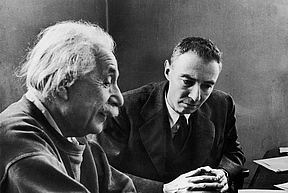
Much has been written about physicist J. Robert Oppenheimer. Accounts have focused on everything from the substance of his life, his intellect, and his patrician manner, to his leadership of the Los Alamos National Laboratory, his political affiliations and postwar military/security entanglements, and his early death from cancer. For another key period of his life, from 1947–66, Oppenheimer served as the Director of the Institute for Advanced Study, which is the longest tenure of any IAS Director thus far. Oppenheimer's legacy at the Institute is keenly felt today. His focus on intellectual freedom and interdisciplinarity of approach, highlighted by the active role that he took in bringing together scholars from diverse disciplines to address important questions of the day, continues to be exemplified in IAS scholarship.

Born Julius Robert Oppenheimer on April 22, 1904, in New York City, Oppenheimer grew up in a Manhattan apartment adorned with paintings by van Gogh, Cézanne, and Gauguin. His father, Julius Oppenheimer, was a German immigrant who worked in his family's textile importing business. His mother, Ella Friedman, was a painter whose family had been in New York for generations. His younger brother, Frank, would also become a physicist.
In 1921, Oppenheimer graduated from the Ethical Culture School of New York at the top of his class. At Harvard, Oppenheimer studied mathematics and science, philosophy and Eastern religion, and French and English literature. He was admitted to graduate standing in physics in his first year as an undergraduate on the basis of independent study. During a course on thermodynamics taught by Percy Bridgman, Higgins University Professor of Physics at Harvard, Oppenheimer was introduced to experimental physics, which quickly caught his attention. He graduated summa cum laude in 1925 and afterwards went to Cambridge University's Cavendish Laboratory as research assistant to J. J. Thomson. Uninspired by routine laboratory work, he went to the University of Göttingen, in Germany, to study quantum physics. Oppenheimer met and studied with some of the day's most prominent figures, including Max Born and Niels Bohr. In 1927, Oppenheimer received his doctorate, and in the same year, he worked with Born on the structure of molecules, producing the Born-Oppenheimer Approximation. Subsequently, he traveled from one prominent center of physics to another: Harvard, California Institute of Technology, Leyden, and Zürich. In 1929, he received offers to teach at Caltech and the University of California at Berkeley. Accepting both, he divided his time between Pasadena and Berkeley, attracting his own circle of brilliant young physics students.

“His lectures were a great experience, for experimental as well as theoretical physicists,” commented the late physicist Hans Bethe (1906–2005), who would later work with Oppenheimer at Los Alamos. “In addition to a superb literary style, he brought to them a degree of sophistication in physics previously unknown in the United States. Here was a man who obviously understood all the deep secrets of quantum mechanics, and yet made it clear that the most important questions were unanswered. His earnestness and deep involvement gave his research students the same sense of challenge. He never gave his students the easy and superficial answers but trained them to appreciate and work on the deep problems.”
When Julius Oppenheimer died in 1937, Oppenheimer became a wealthy man. In 1940, he married Katherine (Kitty) Puening Harrison, a biologist and divorcee whose second husband had been killed during the Spanish Civil War. The couple had two children, Peter and Katherine.
World War II interrupted the work and lives of most American physicists. In 1942, Oppenheimer was appointed to the Manhattan Project, code name for the project formed to develop an atomic bomb.
The project involved several laboratories in secret locations across the country, including the University of Chicago; Oak Ridge, Tennessee; and Los Alamos, New Mexico. Oppenheimer oversaw the construction of the Los Alamos laboratory, where he gathered the best minds in physics to work on the problem of creating an atomic bomb. Because of his leadership in this project, he is often referred to as the “father” of the atomic bomb.

When the war ended, the government set up the Atomic Energy Commission (AEC) to replace the Manhattan Project. The AEC was charged with overseeing all atomic research and development in the United States. As Chairman of the General Advisory Committee, Oppenheimer opposed the development of the hydrogen bomb. Known as the “Super Bomb,” the hydrogen bomb was a thousand times more powerful than the atomic bomb. In the context of the Cold War, when the United States and the Soviet Union jockeyed for power, Oppenheimer's stance was controversial. In the 1950s, while Oppenheimer was Director of the Institute, anti-Communist hysteria was sweeping through Washington, D.C., spearheaded by the conservative Senator Joseph McCarthy of Wisconsin. McCarthy and anti-Communist zealots devoted themselves to rooting out Communist spies from every walk of American life. Oppenheimer was subjected to a security investigation that became a cause célèbre and divided the intellectual and scientific community. In 1953, he was denied security clearance and lost his position with the AEC. Doors that had formerly been open to him were closed. “Oppenheimer took the outcome of the security hearing very quietly but he was a changed person; much of his previous spirit and liveliness had left him,” recalled Bethe.
Oppenheimer’s concern for the general public’s lack of scientific understanding, and the difficulty of conveying the content of scientific discoveries as well as the exhilaration of the creative act of discovery to even educated lay people, led to several popular essays on science. He delivered the Reith Lectures on the BBC in 1953, and these were published under the title “Science and the Common Understanding.”
In April 1962, the U.S. Government made amends for the treatment Oppenheimer suffered during the McCarthy years, when President Kennedy invited him to a White House dinner of Nobel Prize winners. In 1963, President Johnson awarded Oppenheimer the highest honor given by the AEC, the Fermi Award.
Oppenheimer died of throat cancer on February 18, 1967.
A number of plays have been written about Oppenheimer, and American composer John Adams (Nixon in China) composed an opera commissioned by the San Francisco Opera entitled Doctor Atomic, which premiered in September 2005. There are also a large number of books on Oppenheimer and his life, including J. Robert Oppenheimer: The Brain Behind the Bomb (Inventors Who Changed the World) by Glenn Scherer and Marty Fletcher (Myreportlinks.com, 2007) and Oppenheimer and the Manhattan Project: Insights into J. Robert Oppenheimer, “Father of the Atomic Bomb,” by Cynthia C. Kelly (World Scientific Publishing Company, 2006). In addition to this, Oppenheimer's life, work, and legacy were the subject of the multi-award-winning biopic Oppenheimer, released in 2023. Key scenes in the film, directed by Christopher Nolan, were shot on the IAS campus.