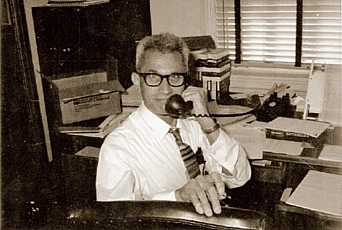
Freeman J. Dyson
Past Faculty
School of Natural Sciences
Mathematical Physics and Astrophysics
Affiliation
Natural Sciences
Website
Freeman Dyson’s work on quantum electrodynamics marked an epoch in physics. The techniques he used in this domain form the foundation for most modern theoretical work in elementary particle physics and the quantum many-body problem. He has made highly original and important contributions to an astonishing range of topics, from number theory to adaptive optics. In recent years, he has been a regular contributor to the New York Review of Books, reviewing books about science and the history of science for the general public.
Visits
Emeritus
School of Natural Sciences
–
Faculty
School of Natural Sciences
–
Member
Math/NS
–
Fall
Member
Math/NS
–
Degrees
University of Cambridge
B.A.
1945
Honors
Awards: The National Space Society's Robert Heinlein Memorial Award 2018; Henri Poincaré Prize 2012; Templeton Prize for Progress in Religion 2000; Enrico Fermi Award 1995; American Association of Physics Teachers, Oersted Medal 1991; Wolf Prize in Physics 1981; Harvey Prize 1977; German Physical Society, Max Planck Medal 1969; American Institute of Physics and American Physical Society, Dannie Heineman Prize for Mathematical Physics 1965
Memberships: National Academy of Sciences; Royal Society; Russian Academy of Sciences
Appointments
Cornell University
1951–1953
Professor
University of Birmingham
1949–1951
Research Fellow